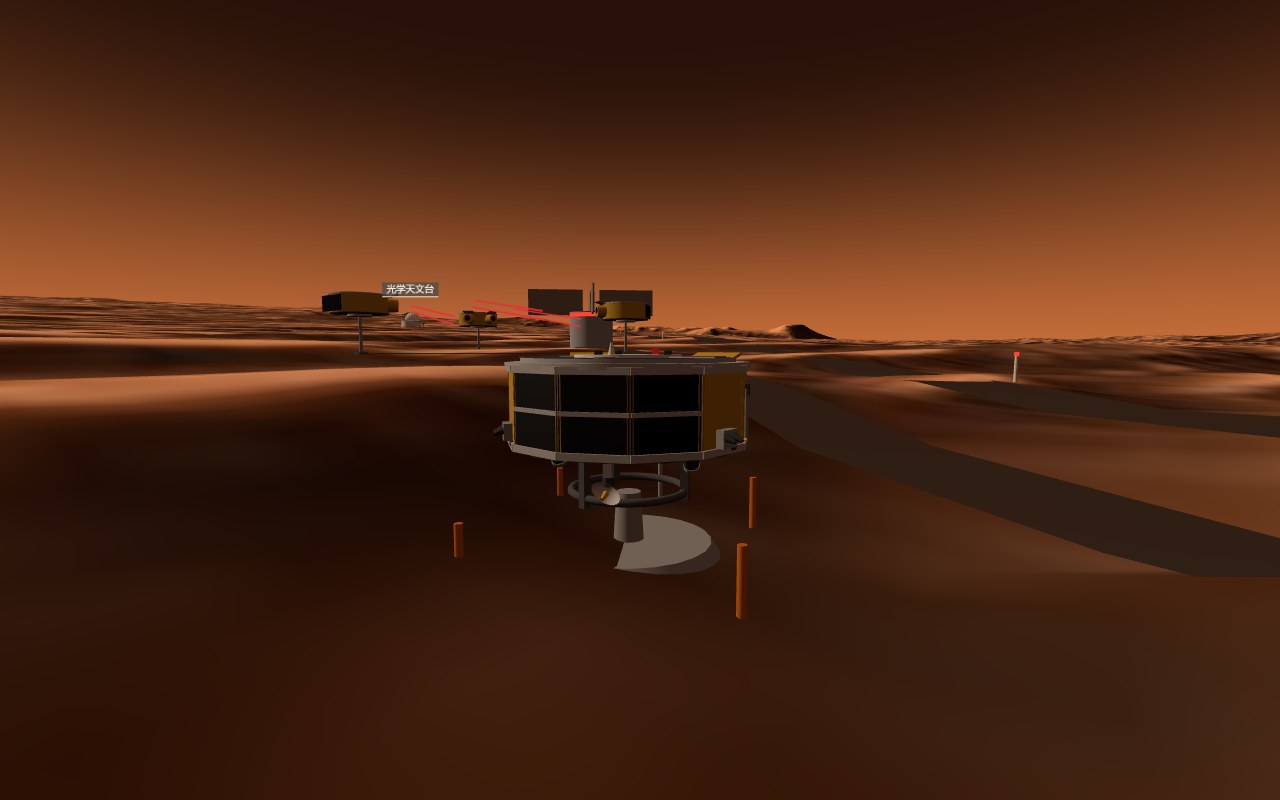
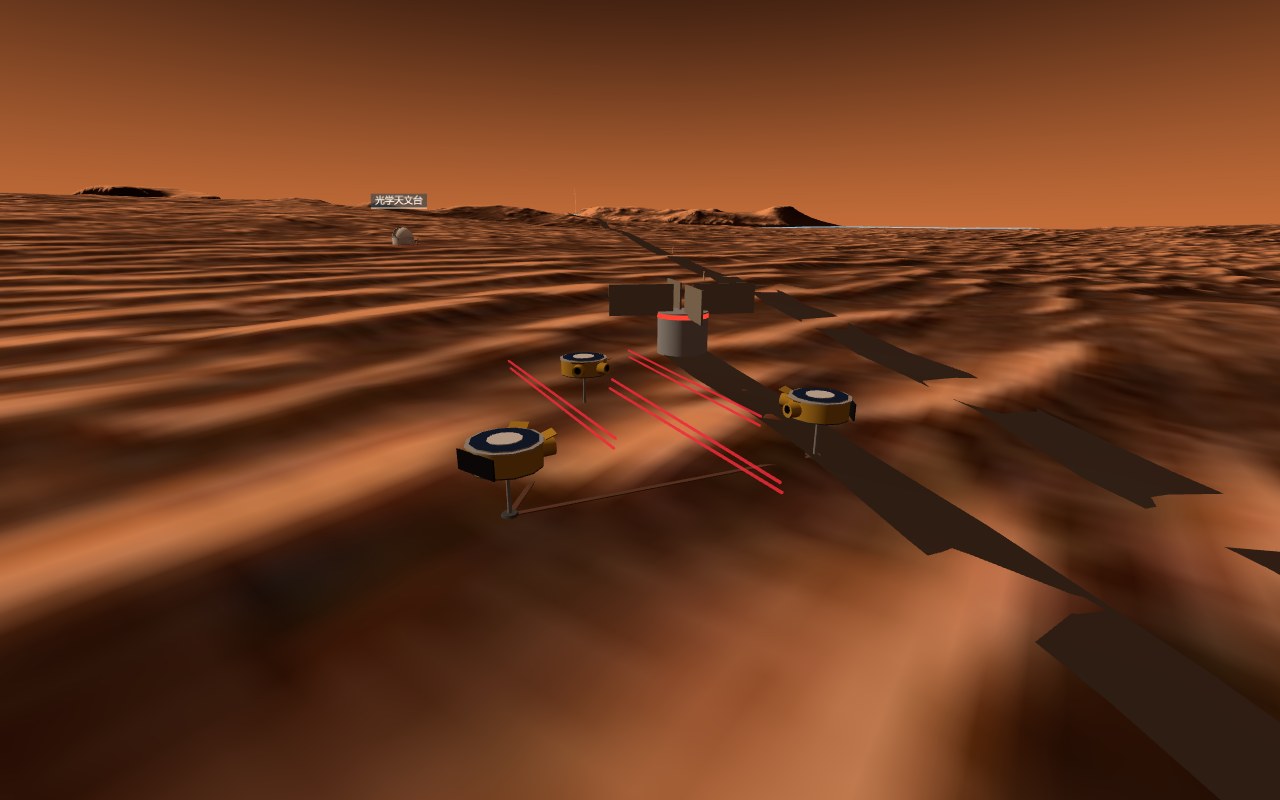
TT-1 is a three-spacecraft laser interferometer on heliocentric orbits, trailing Earth by 20° with 3-million-kilometre arms. It cannot be built on Mars — so the city exhibits it instead: a 1:1 spacecraft with its gold test mass laid open, and a formation display whose breathing motion is integrated orbital dynamics, not hand animation. Every number on this page passed a known-answer gate first.
A millihertz interferometer needs arms longer than ten thousand planets. The city can't host the instrument — it hosts the understanding of it.
Strain from a supermassive black-hole merger arrives at 10-21: measuring it means resolving picometres across millions of kilometres, which is why TT-1 flies as three free-falling spacecraft in deep space. What stands in the science quarter is the teaching version: a full-scale engineering unit on a display cradle, its instrument bay cut open so the causal chain reads in one glance — telescope barrel → Zerodur optical bench → the 46 mm Au-Pt cube floating in its electrode cage. The cube is the whole story: a mass touching nothing, whose only remaining force is gravity.
Next to it, the formation exhibit compresses the constellation 2×10⁸:1 (1 Gm → 5 m) while keeping the spacecraft bodies 1:1. Six red beams close the triangle the way six heterodyne links close the real interferometer.
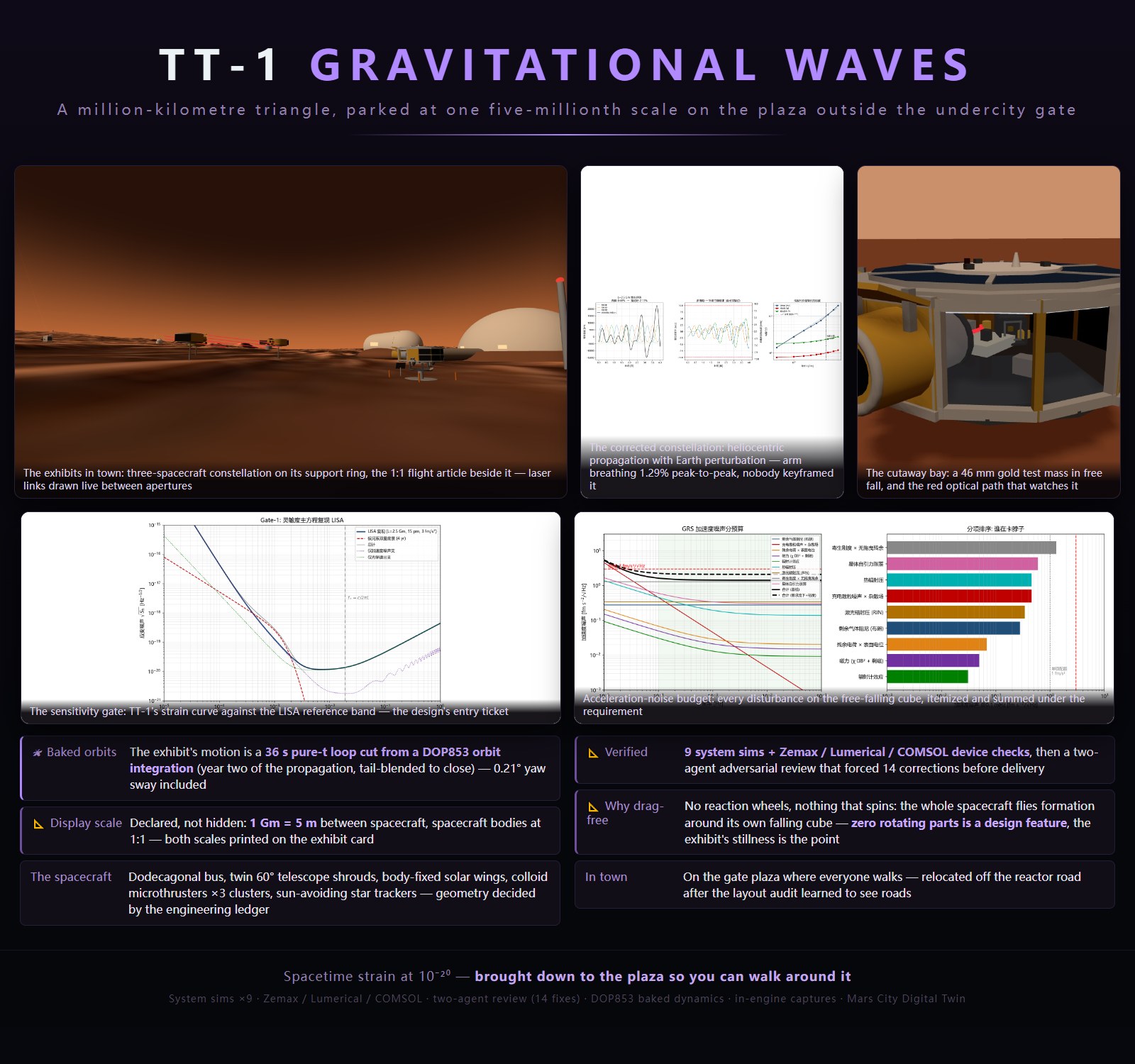
One master equation, two budgets feeding it, and real solvers behind every allocation.
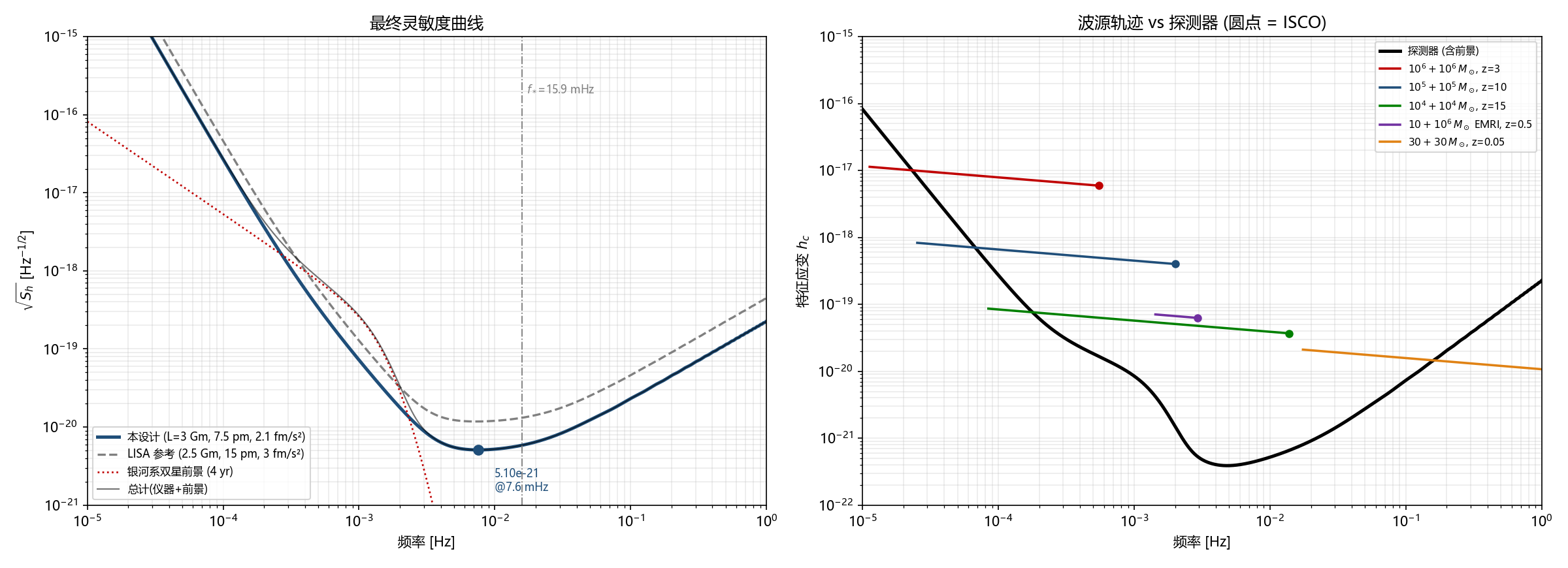
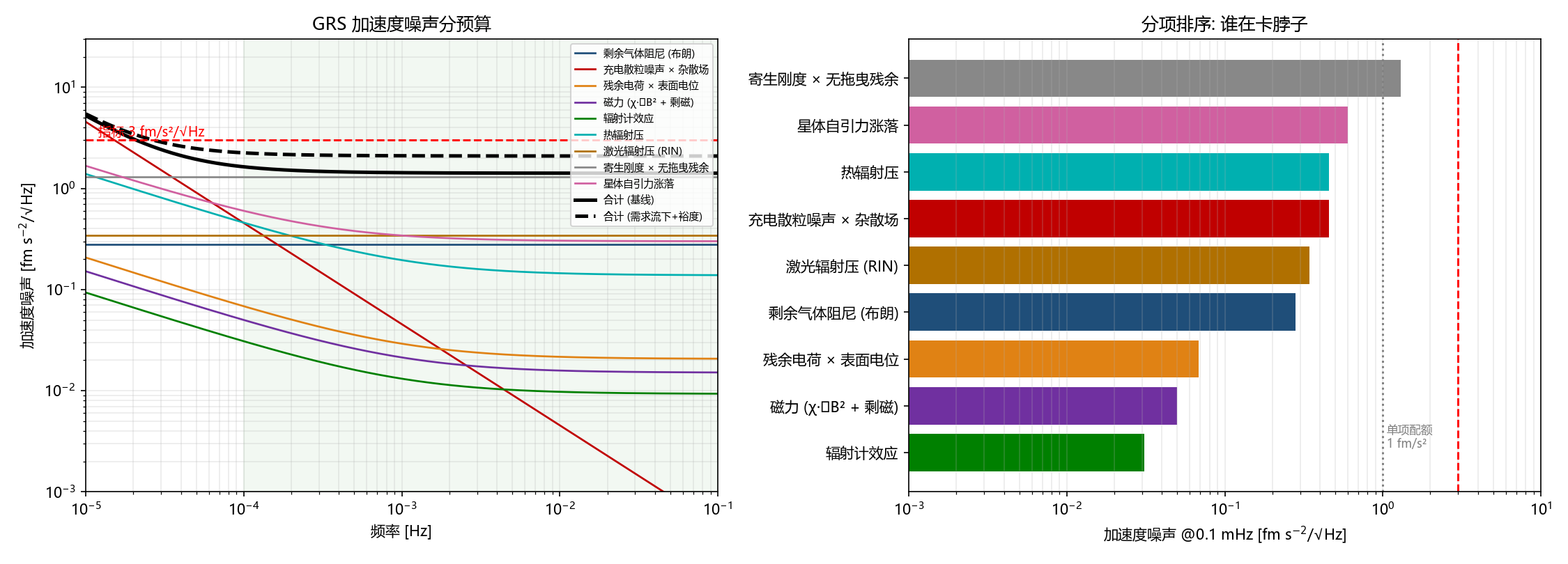
The whole design serves Sh(f) = (10/3L²) [POMS + 2(1+cos²(f/f∗)) Pacc/(2πf)4] [1+0.6(f/f∗)²]. Below a millihertz the (2πf)-4 factor means only residual force on the test mass matters — a nine-term parasitic-force budget (gas damping, charge shot noise, patch potentials, magnetics, radiometer, radiation pressure, stiffness coupling, self-gravity) closes at 2.10 fm/s²/√Hz, gated against LISA Pathfinder flight data. At high frequency the optical chain takes over: an eight-term budget closes at 7.48 pm/√Hz per link.
The allocations are not typed in — they are solved for. Zemax ray tracing confirmed the confocal-paraboloid telescope is aberration-free on axis to 1.9×10⁻¹⁰ waves; a COMSOL→Zemax thermo-elastic loop turned "3 pm of telescope pathlength" into material law (Zerodur survives at 220 µK/√Hz where aluminium needs an impossible 0.19 µK/√Hz); and a self-built two-beam overlap integral put the tilt-to-length coupling on a moment-integral footing, softening the alignment tolerance from 6.25 to 10.7 µm.
No home-built model was allowed to speak about the design before reproducing something the world already knows.
| Gate | Reproduced | Verdict |
|---|---|---|
| Sensitivity master equation | LISA public curve: f∗ = 19.09 mHz; asymptotic slopes −3 / −2 / +1 | pass |
| Waveform & SNR machinery | aLIGO BNS range 220 vs ~190 Mpc; fISCO(2.8 M☉) 1570 vs 1571 Hz; DL(z=1) to 0.03% | pass |
| Optical link | LISA received power: 297 pW vs ~300 pW public | pass |
| Constellation dynamics | LISA orbital elements e=0.0048, i=0.48°; 60.00° plane tilt emerges from i=√3e | pass |
| Acceleration-noise model | LISA Pathfinder in-flight band 1.2–2.5 fm/s²/√Hz | pass, flagged weak — spectral shape not reproduced below 1 mHz, so a 2.0 fm/s² unmodelled reserve is carried |
The same discipline runs deeper than these five: the FEM was gated on the exact stress-free solution of a linear thermal field (hit to 0.00–0.47%), the wave-optics overlap on a closed-form complex-Gaussian integral (0.00%), and the transmit-aperture efficiency on the literature optimum 0.81 at w=0.89R — reproduced as 0.8145 at 0.890R. A gate that passes too easily is itself a finding: one gate window had to be widened after it was caught hiding a real bug (see 06).
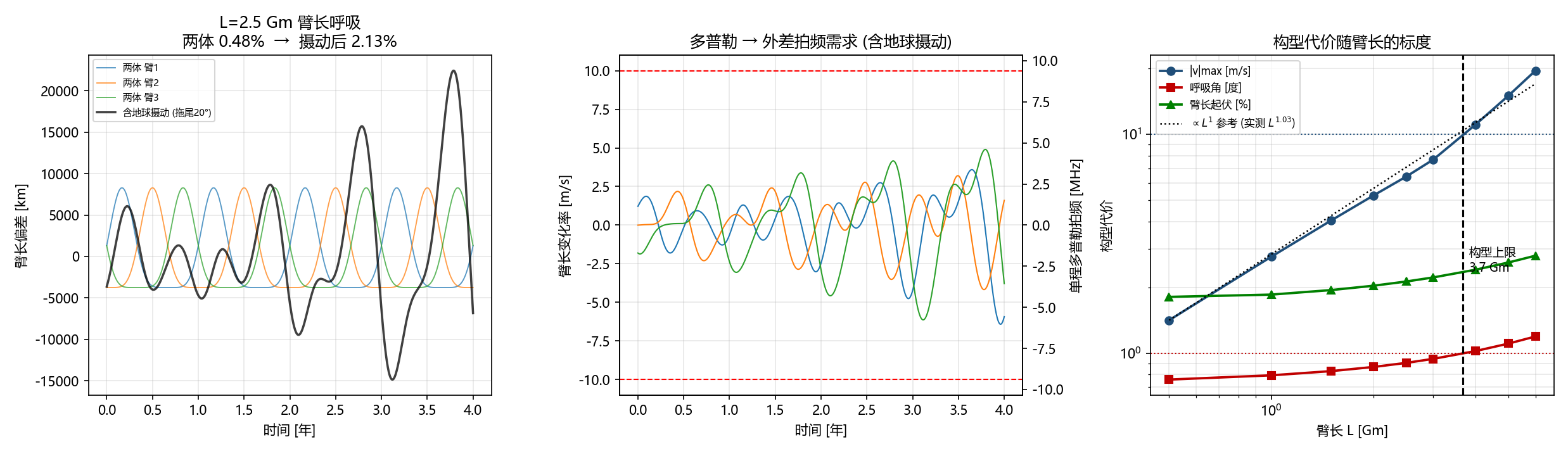
The exhibit's motion loop is a baked year of Sun + Earth-perturbation integration — 1.29% arm breathing, 0.21° yaw wobble, zero keyframes.
Three spacecraft on one shared semi-major axis, eccentricity and inclination vectors rotated 120° apart with i = √3 e: the first-order relative orbit is a circle, so the triangle stays equilateral — and the 60° tilt of its plane is algebra, not a choice. Earth then spoils the ideal: a DOP853 propagation with Earth's point mass shows the formation destroyed at 0° trailing (274% arm flexing) and settling to 2.13% at 20° — the trailing angle is a stability-versus-comm-distance compromise you can read straight off the scan.
The display asset samples year two of that propagation into 120 frames, blends the tail into the head for a closed 36 s loop, and drives each craft's yaw along the baked arm-bisector. Any time offset is a valid entry point; three instances could run phase-shifted. What you see wobbling above the regolith is the actual celestial mechanics that caps the arm length of every space interferometer.
Every number above, and which run produced it.
| Claim | Value | Produced by |
|---|---|---|
| Peak strain sensitivity | 5.1e-21 /√Hz @ 7.55 mHz | gravity-wave/sim/07_performance_science.py |
| Seed-BH merger SNR (z=10, std convention) | 103 | gravity-wave/sim/07 + sim/gwlib.py |
| LISA gate: f∗ and slopes | 19.09 mHz; −3/−2/+1 | gravity-wave/sim/01_sensitivity_core.py |
| aLIGO gate: BNS range | 220 Mpc (ref ~190) | gravity-wave/sim/02_gate_snr.py |
| Constellation elements; plane tilt | e=0.00580, i=0.5735°; 60.00° | gravity-wave/sim/04_constellation_orbit.py |
| Test-mass acceleration budget | 2.10 fm/s²/√Hz | gravity-wave/sim/05_acceleration_budget.py |
| Per-link displacement budget | 7.48 pm/√Hz | gravity-wave/sim/06_optical_budget.py |
| Telescope on-axis WFE; exit pupil | 1.9e-10 waves; 5.000000 mm | gravity-wave/opt/01_telescope.py (Zemax ZOS-API) |
| Thermal soak allowance: Zerodur vs Al | 220 vs 0.19 µK/√Hz | gravity-wave/opt/03_thermal_opl.py |
| Gradient / absorbed-power allowance | 214 µK/√Hz; 9.9 µW/√Hz | gravity-wave/fem/tel_grad.java + fem/analyze_fem.py (COMSOL 145k DOF) |
| TTL lever correction; alignment tolerance | η=0.586; 6.25→10.7 µm | gravity-wave/opt/06_ttl_wave.py |
| TX aperture efficiency (lit. gate 0.81@0.89R) | 0.8145 @ 0.890R | gravity-wave/opt/06_ttl_wave.py |
| Coating phase drift (closed with evidence) | 0.0036 nm/K | gravity-wave/opt/04_coating_lumerical.py (stackrt) |
| Thruster-noise allowance (binding point) | 0.201 µN/√Hz @ 24 mHz | gravity-wave/sim/09_dfacs_loop.py |
| Formation breathing; yaw wobble | 1.29% pk-pk; 0.21° | gravity-wave/model/bake_formation.py (DOP853, year 2) |
| Received optical power at 3 Gm | 651 pW | gravity-wave/sim/03_arm_trade.py (LISA-calibrated link) |
A two-agent independent review corrected fourteen defects. Four of them are worth retelling.
The galactic-foreground fit's κ and γ went in as 0.00521 and 0.00713 instead of 521 and 1680. Both carry units of Hz-1, so κ·f must be O(1) — a dimensional sniff test that was skipped. The high-frequency cutoff vanished and the foreground stayed 7.9×10⁵ too high at 10 mHz. Worse: the validation gate's window ended at 5 mHz, right before the bug became visible. Both were fixed; the gate now checks that the foreground is invisible at 10 mHz, which any public LISA plot shows.
The design doc originally argued "shot-noise-limited strain is independent of arm length, so longer arms buy nothing at high frequency." The algebra is right — but this design is not shot-noise limited: the length-independent noise floor (5.69 pm) exceeds shot noise (4.85 pm), so h ∝ 1/L holds and longer arms pay everywhere. The best argument for the chosen 3 Gm had been written as an argument against it. The plot's own caption contradicted its own curves, 12× apart, on the same page.
The FEM's relative mirror decenter missed the exact analytic value by 102% while the relative tilt matched to 0.03%. Fingerprint of a frame-invariance bug: u(M2)−u(M1) is not invariant under the rigid-body rotation that the solver's motion suppression injects — the tilt difference is. Correcting to the M1-frame quantity, dDec = (u₂−u₁) + tilt₁·z₂, landed on the analytic answer to 0.04%. One quantity right and its sibling wrong is diagnostic gold.
First render of the formation exhibit: every beam converged on the triangle's centre — too tidy to be random. The aperture-lookup function used two scratch vectors internally while its callers used the same two vectors to hold both endpoints; the second call overwrote the first result with a unit vector near the origin. Shared mutable scratch versus output containers. Suspiciously regular wrongness is a shared-state signature.
Both exhibits are live city assets with bilingual knowledge cards.
Open the viewer with viewer/index.html?colony=1&inspect=tt1-formation-01 or walk to the science quarter around (-430,-150). Eleven POI cards (EN/中文 toggle in the viewer) carry the same ledger numbers as this page — 651 pW, 2.10 fm/s²/√Hz, 220 µK/√Hz all resolve to the runs listed above.
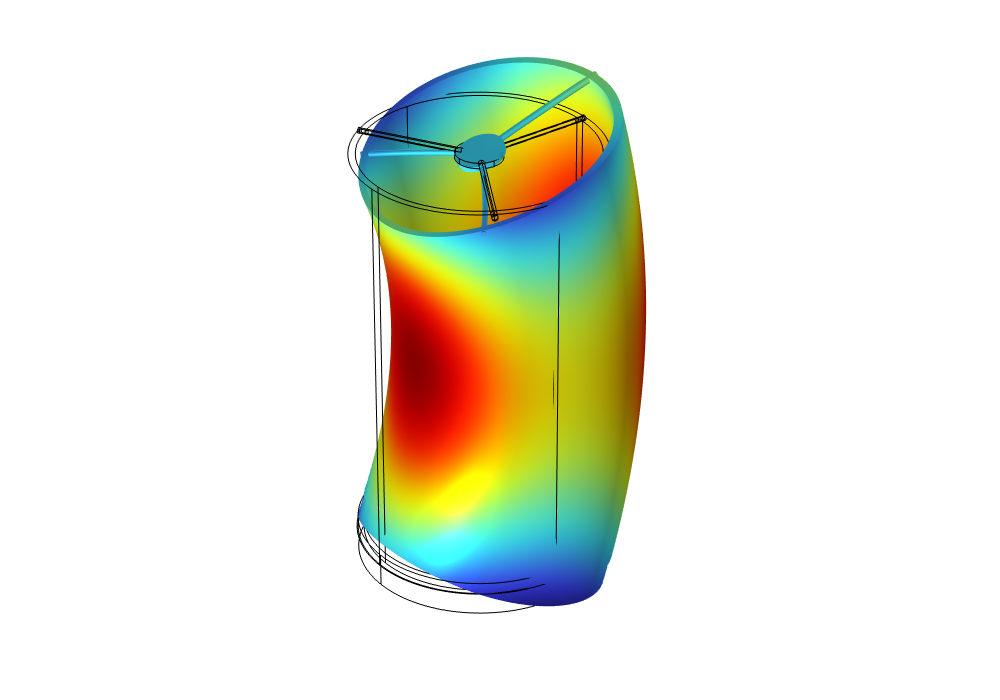
Things worth catching: the gold cube behind the cutaway wall of the 1:1 spacecraft; the beams landing exactly on the telescope apertures while the triangle breathes (watch ~36 s for a full baked year); the MGA gimbal — deliberately the only moving part, because a drag-free platform tolerates no reaction wheels; and the spec plaque's claim that the whole thermal design collapses to one line: 2×10⁻⁴ K/√Hz along the metering path.