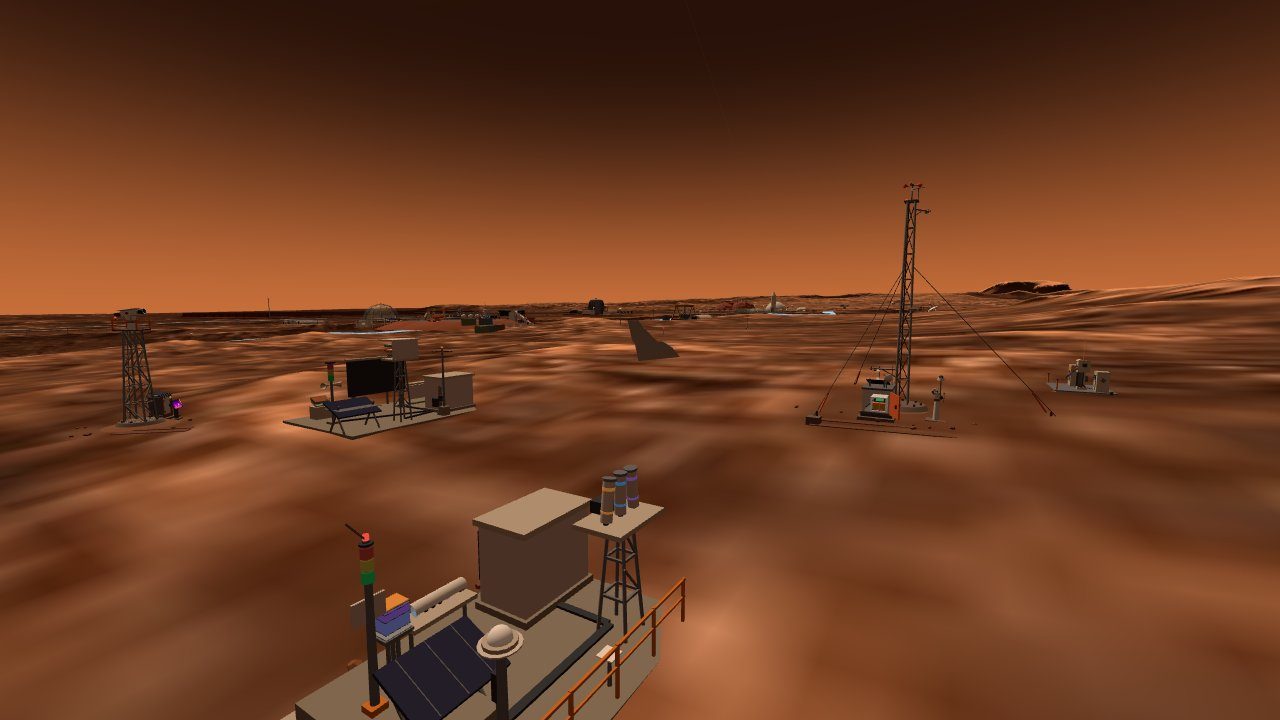
Two stations stand 28 m apart on the north-east highland, wired to the same alarm bus: a 10 m lattice mast that measures the air, and a Timepix4 particle camera that measures what comes through it. A net of silicon-carbide sentinels covers the rest of the depth axis — a trio on the fusion perimeter, one thirty metres down, one at three kilometres. When a storm arrives they all report, and the most informative report comes from the deepest one, which stays silent.
Not a science site — an operations tripwire. Everything here exists because something else in the city has to stop when a number crosses a line.
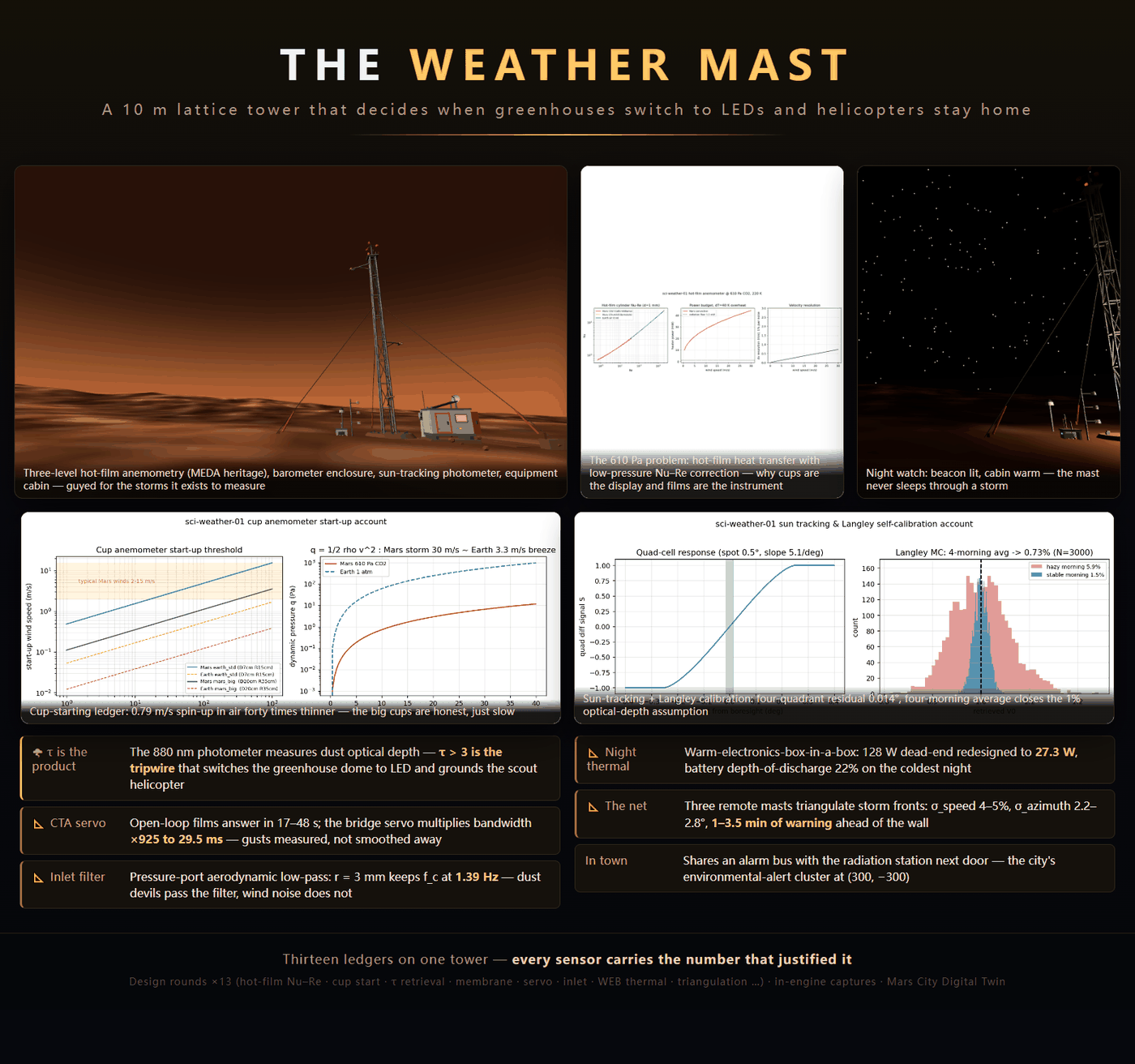
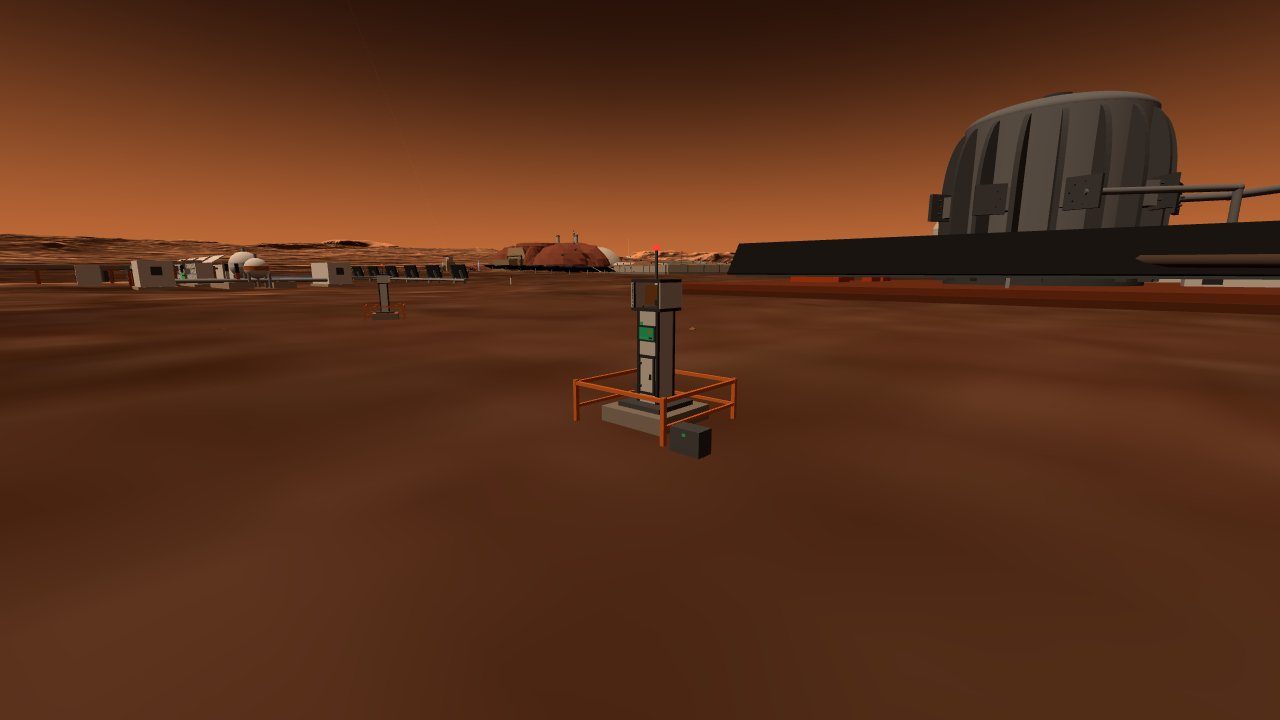
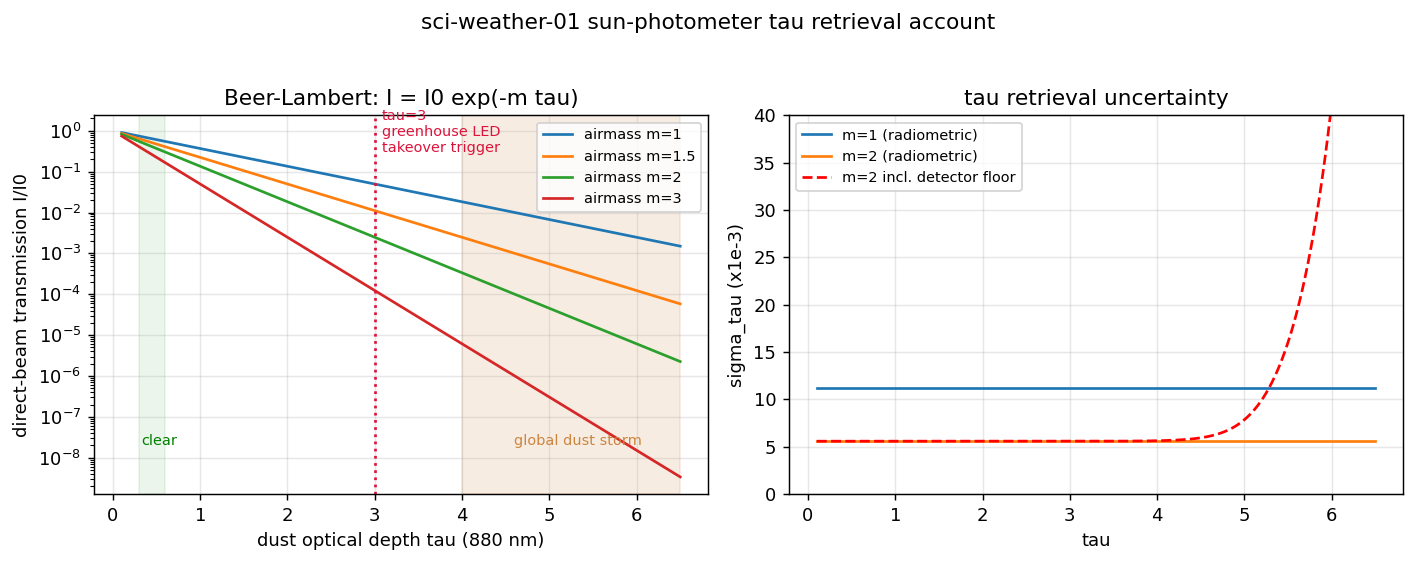
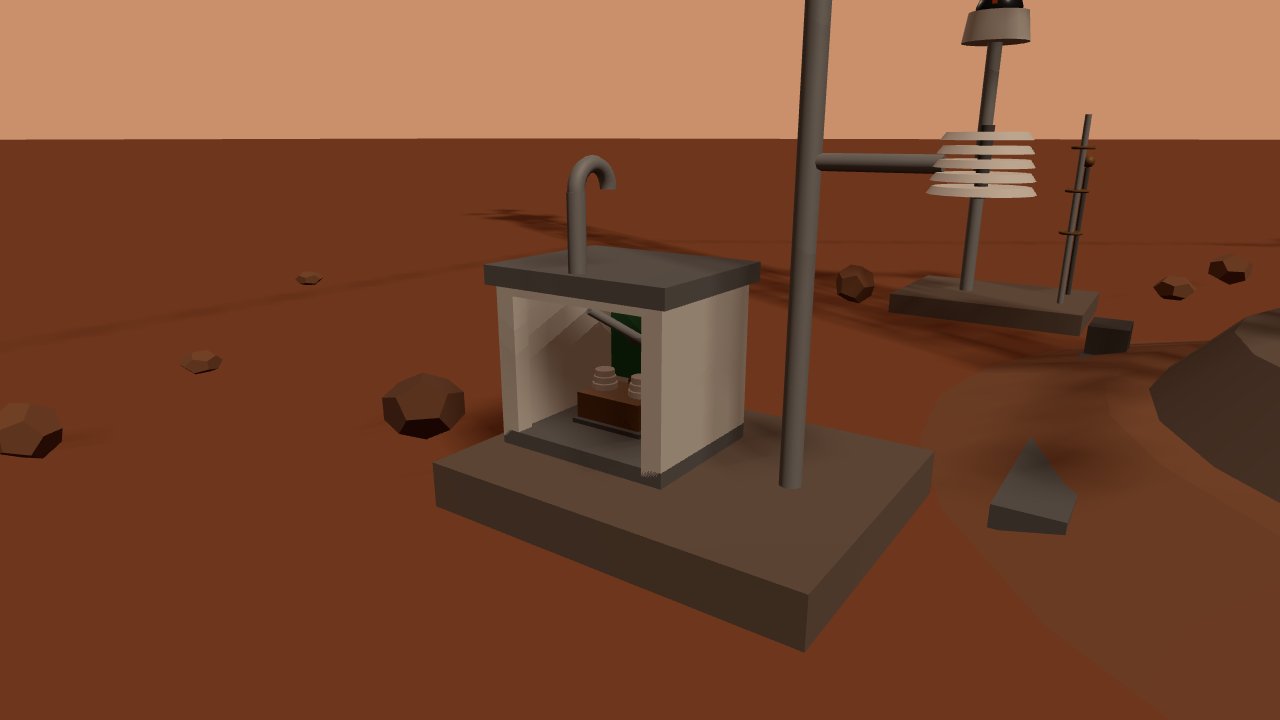
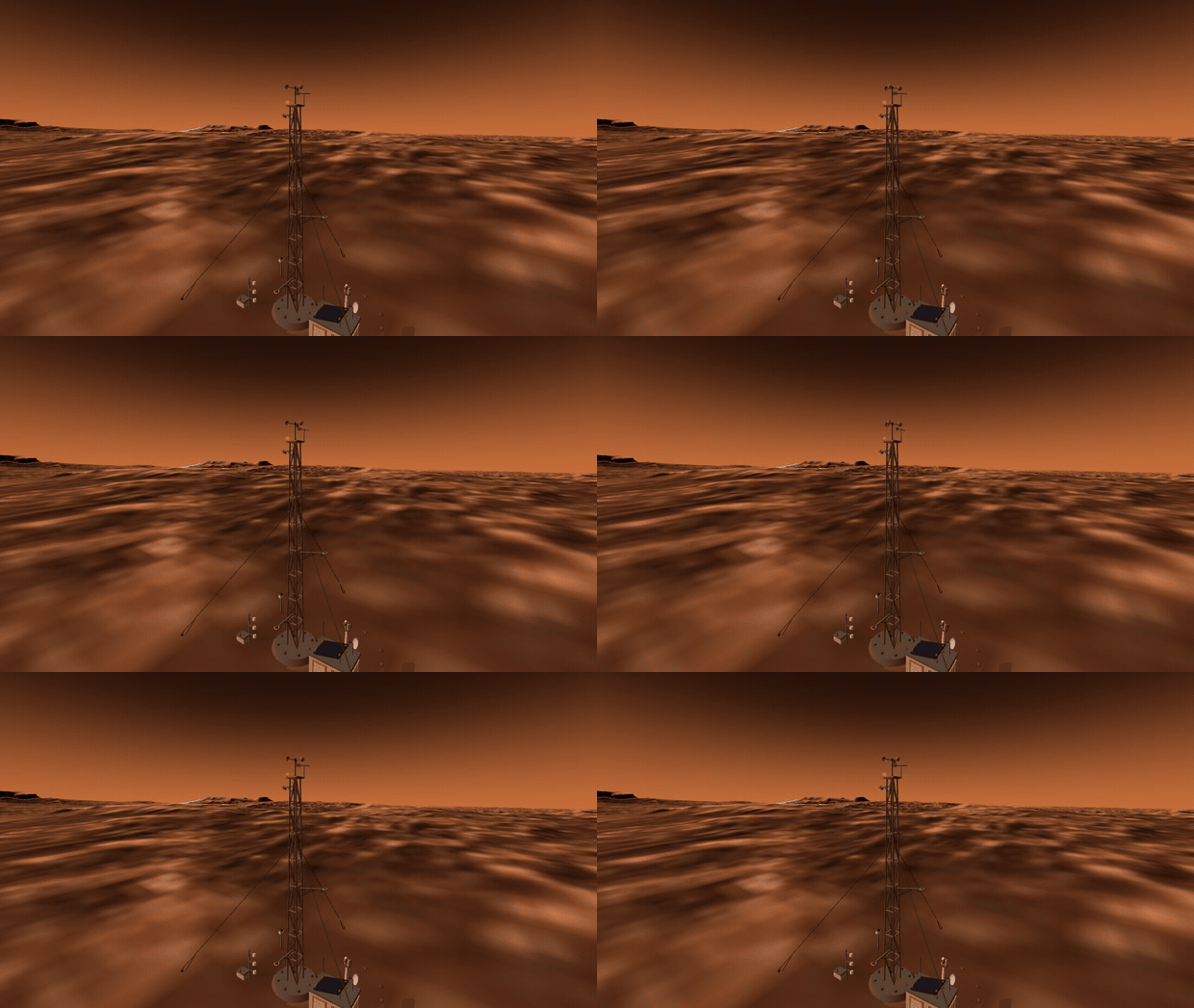
The weather mast at (300, −300) carries three-level hot-film anemometry, a barometer enclosure, an air-temperature shield stack and a sun-tracking photometer. The photometer is the point: it measures dust optical depth τ, and τ is what the rest of the city subscribes to. Past τ = 3 the direct solar beam is down to 2.7% and the greenhouse dome switches its light budget to LEDs; the same threshold grounds the scout helicopter and freezes outdoor lifting. Three remote poles scattered 1.5–2.2 km out turn a single reading into a vector — where the front is coming from, and how many minutes are left.
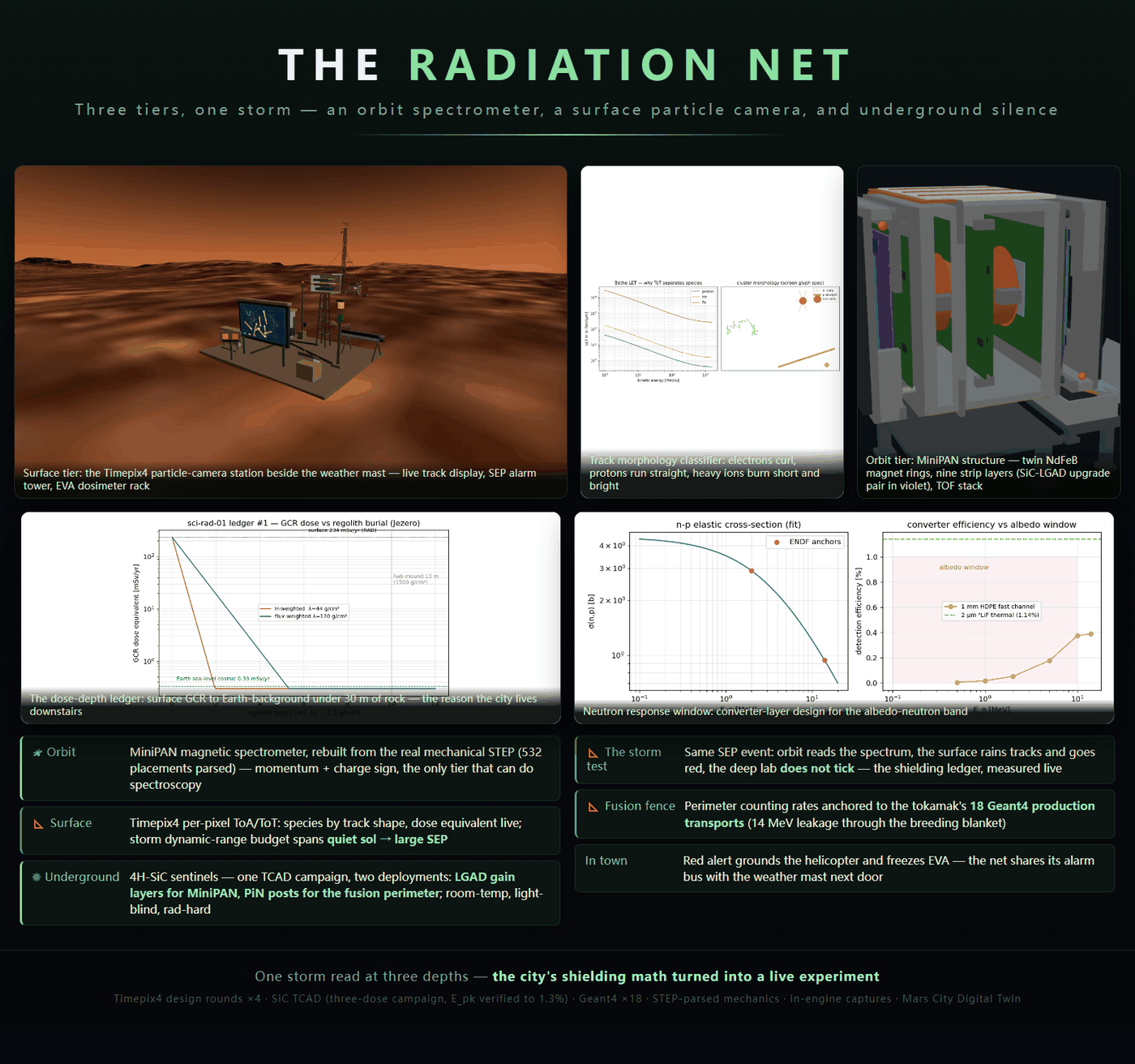
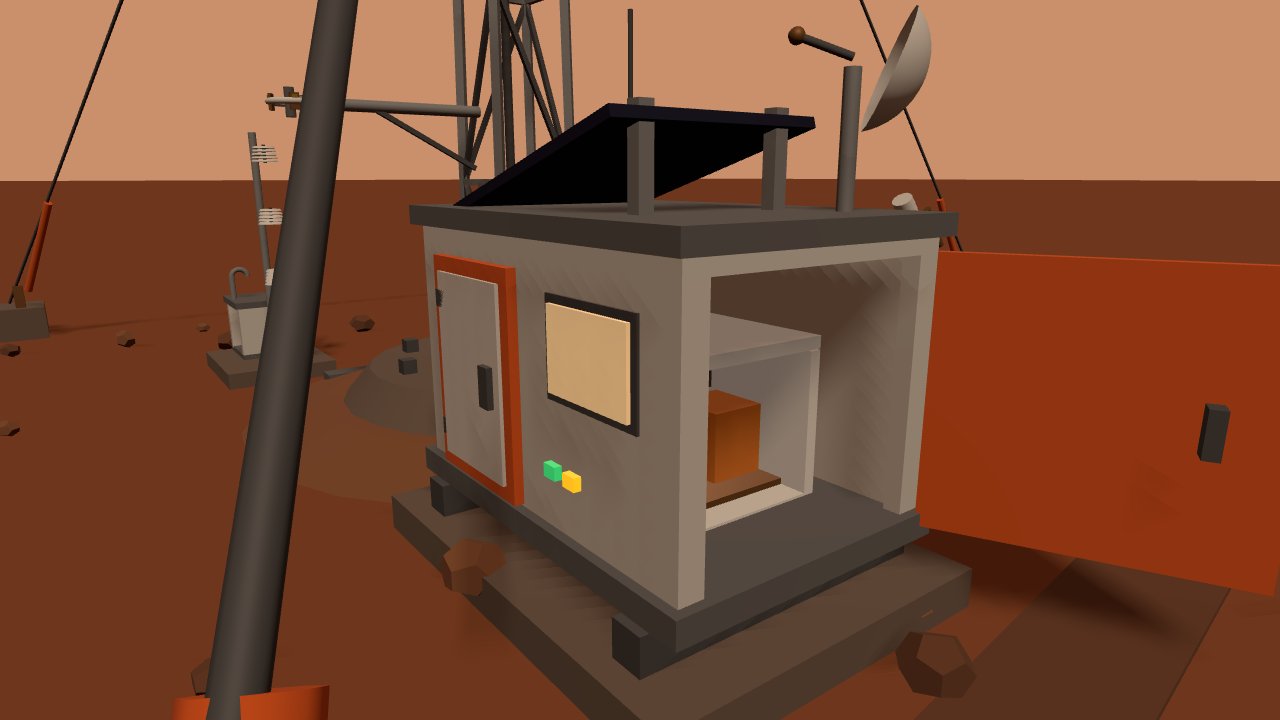
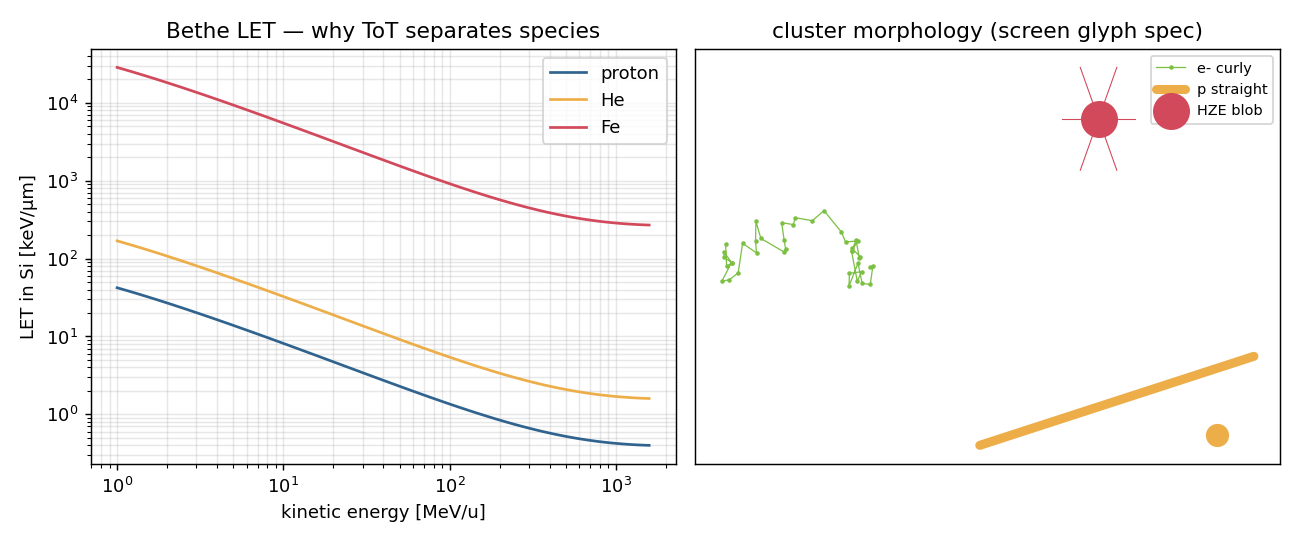
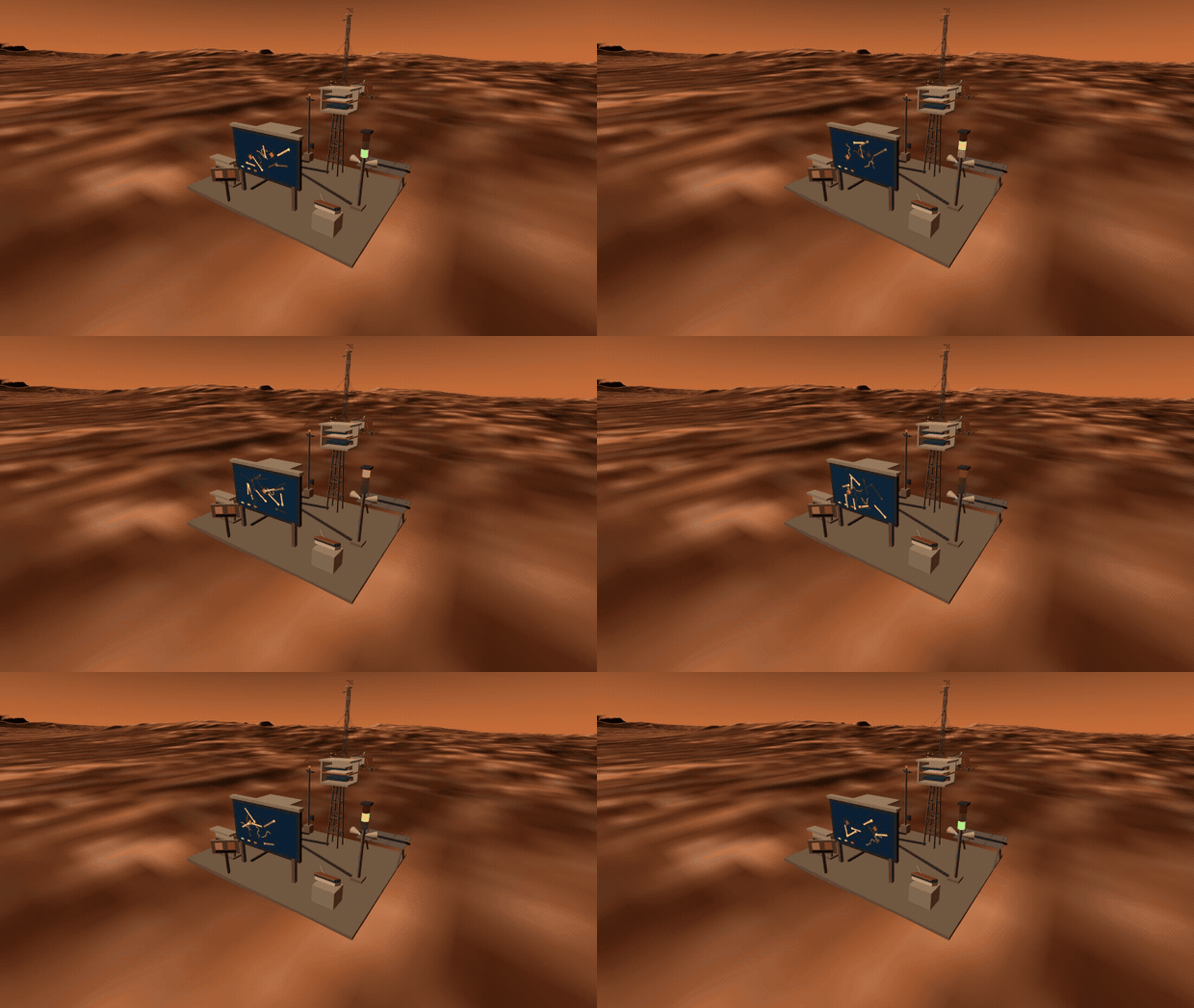
The radiation station 28 m away answers a different question with the same urgency. Its Timepix4 camera records every particle as a track, and classifies by track shape rather than by energy: electrons curl, protons run straight, heavy ions burn short and bright. A solar particle event announces itself as a change in the picture, not in a single scalar. Both stations drive the same red lamp.
The city also runs a spectral tier — thermal-IR, UV and terahertz sounding stations that profile temperature, ozone and water vapour rather than raising alarms. Those live on The Spectrum Net.
The same event, read by instruments separated by kilometres of rock. The differences between their readings are the city's shielding calculation, measured live.
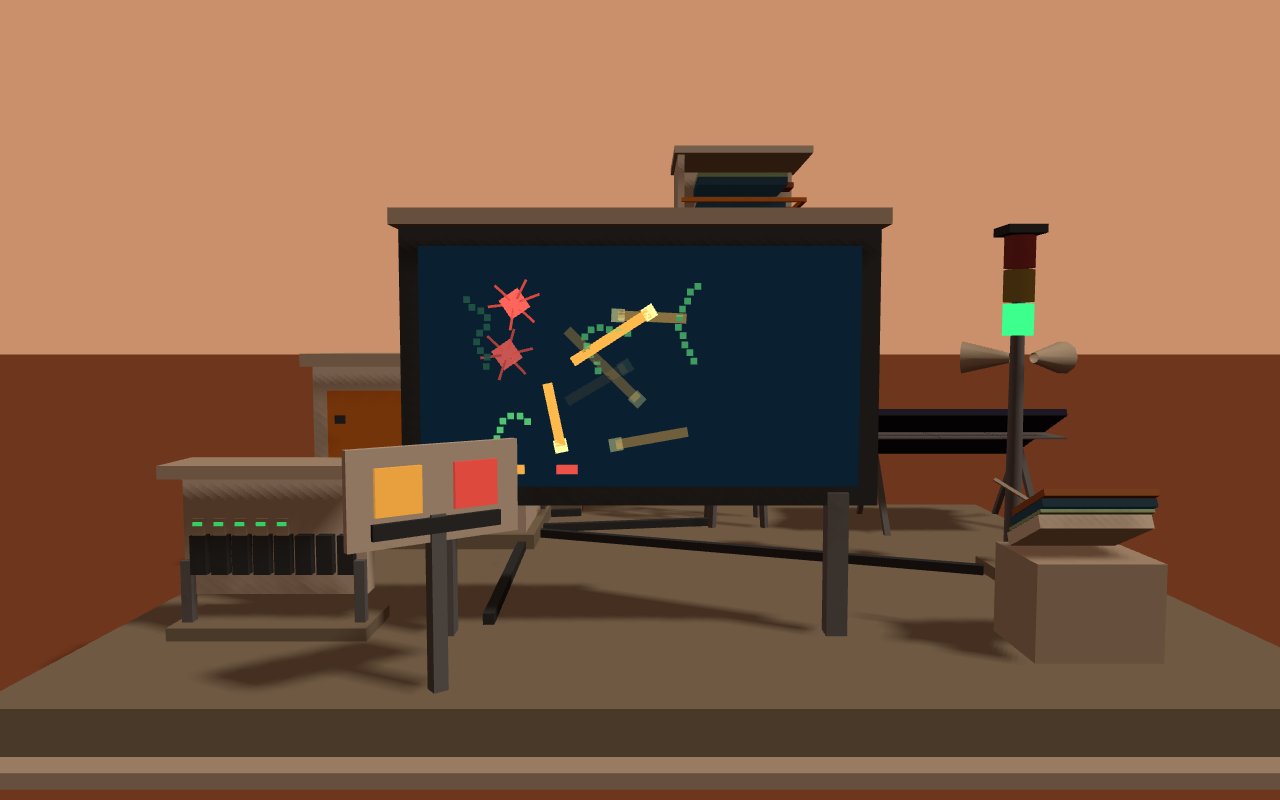
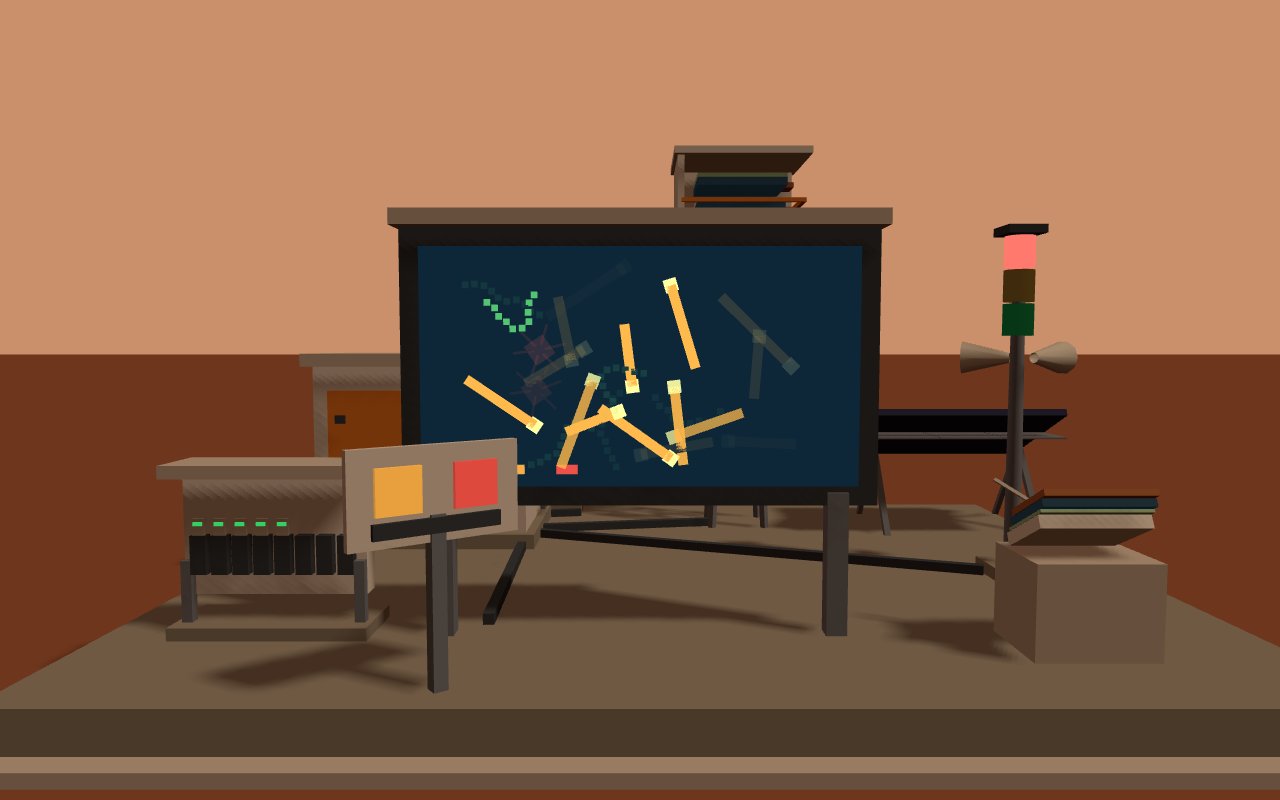
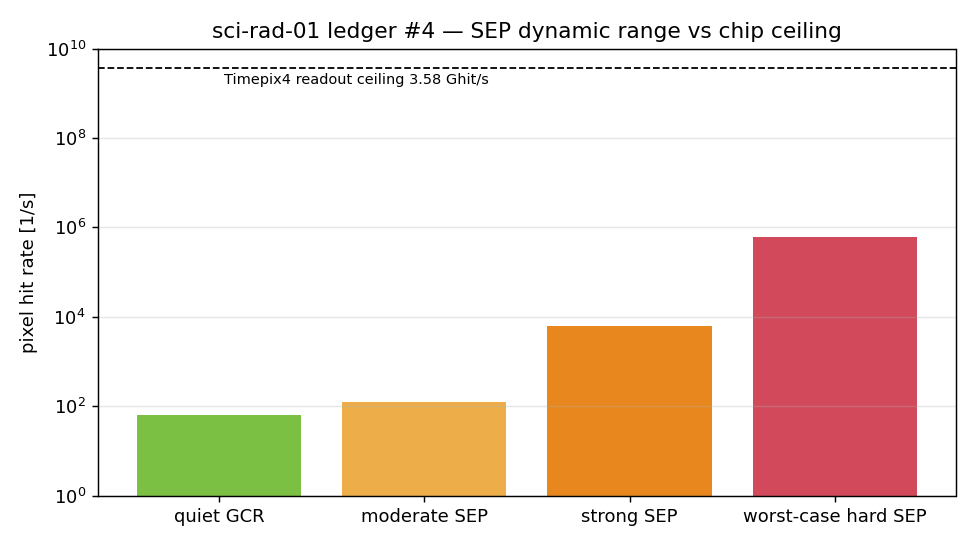
When a solar particle event reaches Mars, the surface camera's screen changes character within a minute: the sparse mix of curls and bars becomes a downpour of orange proton tracks, and the alarm tower steps from green to red. The trigger is deliberately dumb — a one-minute sliding count, green below 3× quiet, red above 30×. Quiet-rate Poisson noise is about 1.6% per minute, so even the low threshold sits more than 20σ out; false alarms are not the failure mode worth engineering against.
Thirty metres down, in the undercity foyer, the same event is nearly invisible. Rock annihilates the hadronic component — 30 m is 7800 g/cm², about 52 hadronic e-foldings — and what still trickles through is almost pure muon flux, ×0.03 of the surface value. On an 8 cm² sentinel that is one count every 83 seconds, storm or no storm.
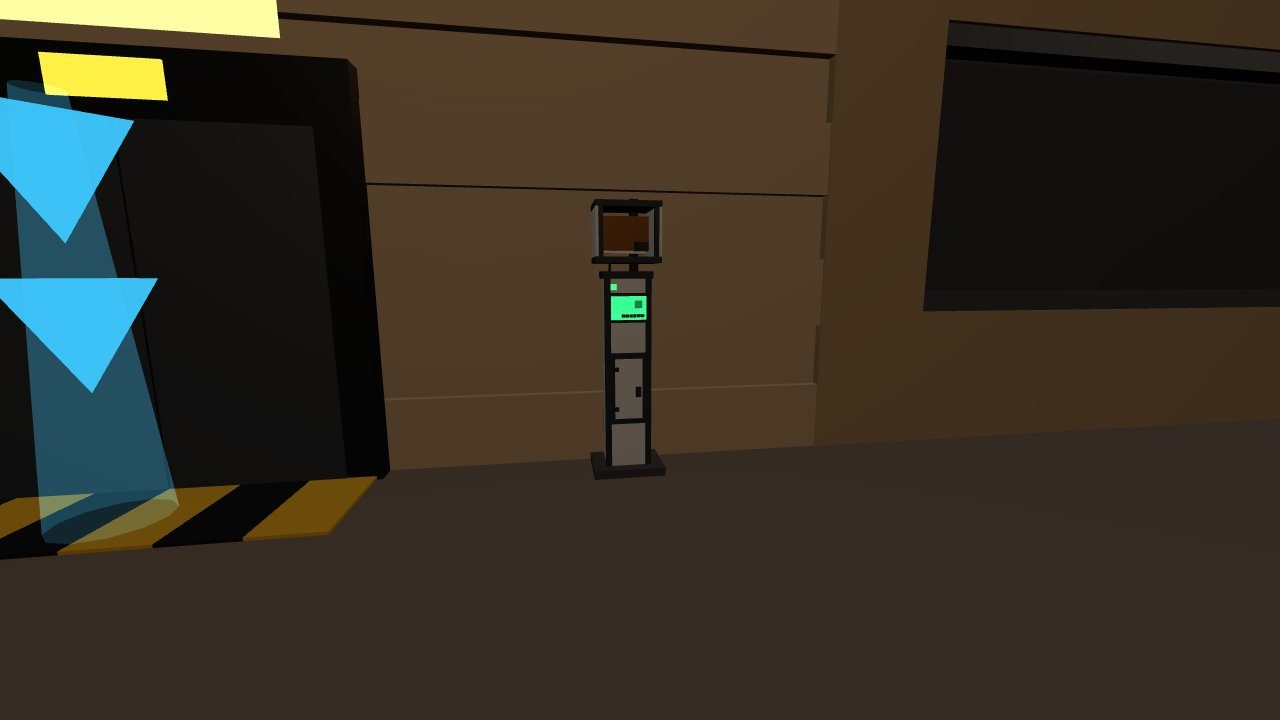
At 3 km, the deep-lab sentinel does not respond at all. Muons are down by another factor of 3×10⁻⁵ and the neutron background has fallen to the bare rock's own U/Th (α,n) floor. Combined, that is roughly one count every 26 days. The instrument's job there is to be boring: the dark-matter experiment above it stakes a 70 t·yr exposure on the premise that this column is quiet, and this is the column that checks the premise.
Since 2026-09-21 this figure comes from a corrected chain. The per-joint bias measured on 2026-09-19 turned out to have a cause: four lines of the transport chain's re-launch rebuilt each neutron's tangential direction wrongly and turned it toward the wall normal at every joint. It was found by flying a recorded source through 0.15 m of vacuum, which cannot change a direction, and seeing that it did. With the launch corrected the escape value through the 0.30 m bio-shield is 3.299×10⁻¹¹ (it was 4.391×10⁻¹¹), the fence reads 0.66 counts/s ±11.9%, and the bias left in borated concrete is +1.1 points per joint with an honest error of 0.8 — so the second row, 0.61 (0.44–0.88), now lies on both sides of the first, and the old remark that the unapplied figure is “the comfortable one for the fence” is retired with the rows it described. Only one of the six joints has such a reading; one more is an identity by measurement. On 2026-09-23 a longer unsegmented reference run, the only direct test of real interface joints, read the first two: chain over reference 0.938 ± 0.066, compatible with one — no measurable residual there. For the two joints still without a reading a placeholder is carried, giving a requirement baseline of 0.43 counts/s (a placeholder load, not a bound), and, for the first time, a mirror load on the other side, 1.16 counts/s, against which the red level's false alarms are graded. On the baseline the change alarm now meets its own “threefold within 60 s” (52 s); it still misses at one statistical corner (68 s), a miss the user accepted on 2026-09-24 as it stands — the alarm line was not moved to close it. Everything below this sentence is the record of how the figure got here. The escape value behind this figure was re-derived for the machine's own geometry on 2026-09-13: 4.391×10⁻¹¹ through the 0.30 m bio-shield, 0.377 of the one-dimensional model's 1.164×10⁻¹⁰, the inboard stack and the ring source halving the first crossing. Flux and count rate are linear in it, so the earlier 62.5 n·cm⁻²·s⁻¹ and 2.32 counts/s (retired 2026-09-19) become about 23.6 and 0.87 — a blip every 1.1 s, roughly 540× the ambient GCR neutron floor (sentinel recompute, 2026-09-19: 0.874 counts/s, 23.6 n·cm⁻²·s⁻¹ ±10.6%). Later the same day the joint bias was measured on the machine chain itself: +5.6 percentage points per joint, the chain over-reporting, the hold released. For the shield the unapplied figure is the conservative one to quote; for this fence it is the comfortable one, so two rows now stand side by side and are never merged — 0.87 counts/s as printed, and 0.63 (0.45–0.90) if the bias measured in borated concrete holds on all six joints — with a labelled test load at 0.38. On 2026-09-20 the bias acquired a mechanism: the chain's re-launch of each surface source rebuilds the tangential direction component wrongly and turns every neutron toward the wall normal, so every escape value delivered by either chain is over-reported, by an amount nobody yet knows — conservative for the shield, comfortable for this fence. Both rows carry that qualifier until a chain with the corrected launch delivers. Ungated, a 10⁴-fold solar-proton neutron burst reads as ×11 to ×15 on the two rows and at least ×10 across the interval, so the gate stays a requirement. What follows is the state before that measurement, kept: it was then a number without a verdict: the joint-bias condition established on the model chain was never run on the machine chain, so the same arithmetic gives 1.03 counts/s on the radiation station's shallow-probe reading and 2.0 if the joint bias sits at its registered limit with the sign unfavourable for the shield — a test load, not a bound. Nothing bounds the low side, which is the side that hurts this network, and the only bias ever measured (on the model chain) points that way. Five rows in all, none of them the value: 2.02, 1.03, 0.87, 0.66, 0.38 counts/s. Ungated, a 10⁴-fold solar-proton neutron burst would read as a ×5–24 rise here (×31 on the lowest row with the statistical 2σ) — the size of the ten-fold leak the network uses as its reference, which is why the gate is a requirement and the earlier wording “a visible spurious rise, not a catastrophic misreading” is withdrawn. Previously: a blip about every 0.43 s — roughly 1400× the floor (re-anchored 2026-09-02 to the declared 0.30 m bio-shield; the earlier 0.21 → 0.08 counts/s and 12 s cadence sat behind a self-assumed 2 m shield). This one is not listening for space weather at all; it watches 14 MeV leakage through the tokamak's breeding blanket. Since 2026-09-12 the tokamak has answered: its escape value was derived for the one-dimensional model's radii, not the machine's, and is declared pending re-derivation — this figure stands as printed until that lands, and inherits the declaration. The 58 m is measured from the machine axis in the ledger, the module and the manifest, so that reading is settled — see The Radiation Budget.
Hadrons are gone after 52 e-foldings of rock. What still ticks is the muon residual — the shallow tier's occasional blip is almost pure µ.
Muons ×10⁻⁶, neutrons at the radiogenic limit. Proof by silence: if this column ever starts ticking rhythmically, the cavern background has gone wrong.
Why tiers instead of one good detector. Each sentinel measures the transmission of the matter column directly above it, so the ratios between tiers are the measured attenuation of each rock section. The city ends up with its own depth-intensity calibration rather than a handbook value — and the same four-decade span is why no single detector could have done it.
Five instruments worth the detail — three on the mast, two underground — because in each case the obvious terrestrial answer fails outright at 610 Pa, or next to a fusion plant, or under three kilometres of rock.
Martian dynamic pressure is 83× below Earth's: a 30 m/s gale carries 6.6 Pa, the same push as a 3.3 m/s breeze at home. An Earth-standard cup set (7 cm cups, 15 cm arms) would not start turning until 3.44 m/s, missing most of the wind spectrum. The oversized display cups on the masthead start at 0.79 m/s — honest, just slow. The real measurement is made by hot films, as on Perseverance's MEDA.
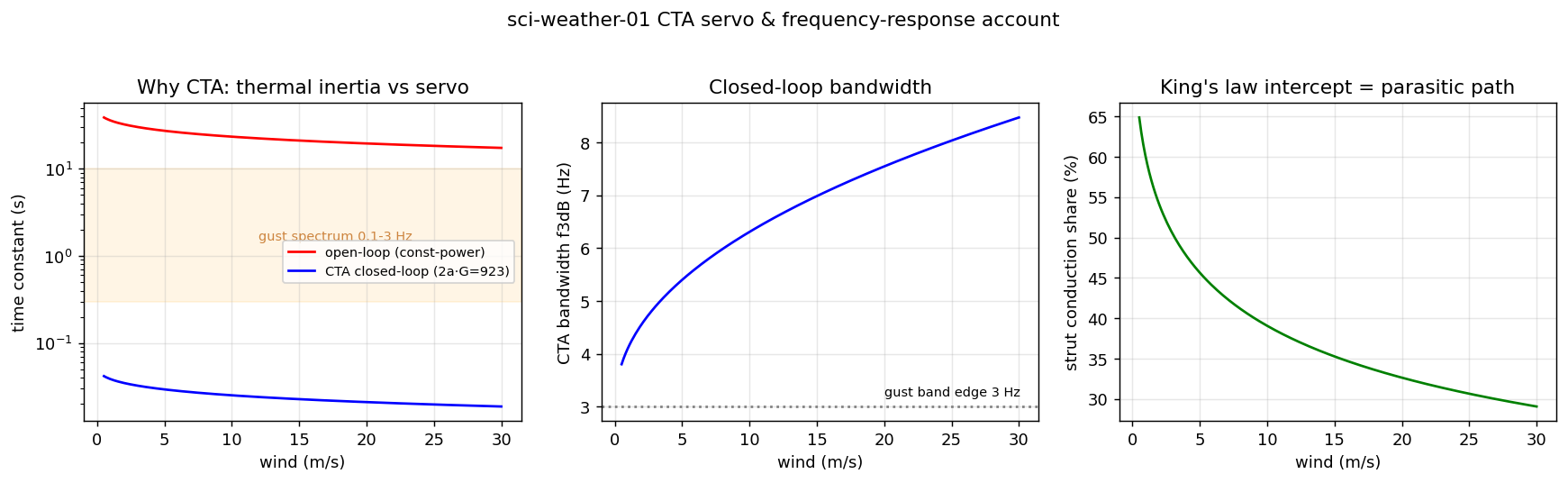
A film left to itself is useless here: its open-loop thermal time constant is 17–48 s, so constant-power heating cannot follow even a 0.01 Hz fluctuation. The instrument is the servo. A constant-overheat bridge pins the film's resistance — hence its temperature — and whatever heat the wind steals, the bridge instantly resupplies; the resupply power is the measurement. That collapses the effective time constant by a factor of ~925 to 29.5 ms (f₃dB 5.4 Hz), which finally covers the 0.1–3 Hz gust band. Three films at 120° resolve direction to 1.4–1.8° — two would leave a mirror ambiguity, three is the minimal unique solver.
The barometer is a vacuum-referenced silicon capsule, and its geometry is set by one collision: the first 18 µm diaphragm deflected 6.2 µm at full scale and would have bottomed out on a 2 µm capacitive gap. Deflection scales as 1/t³, so the shipping part is 40 µm and moves 0.56 µm — 0.1 Pa maps to 10.4 ppm of capacitance, comfortably inside a commodity converter. The intake is not a hole but a filter: pipe resistance times buffer-volume compliance forms a first-order low-pass at 1.39 Hz, deliberately placed so thermal tides and dust-devil transients pass while wind-turbulence noise does not.
τ comes from Beer–Lambert extinction of the direct solar beam at 880 nm, which requires knowing the unattenuated intensity I₀ — and there is no standard lamp on Mars. The Langley method substitutes the atmosphere itself: regress ln I against airmass over a morning and the intercept is ln I₀. A Monte Carlo of that procedure returned a warning rather than a number. On a hazy morning, τ drifting during the sweep inflates σ(I₀) to 5.9% — a single-morning calibration is simply unusable. Screening for stable mornings brings it to 1.5%, and averaging four mornings reaches 0.73%. The 1% calibration term assumed elsewhere on this page is that procedure's output, not an assumption.
The surface field is a mixture — primary galactic cosmic rays, albedo neutrons scattered back out of the regolith, and secondary showers — so the station is built for classified counting and dose equivalent, not spectroscopy (momentum measurement belongs to the orbital magnetic spectrometer on the relay satellite). Timepix4 records per-pixel time-of-arrival and time-over-threshold, which makes species visible as morphology: an electron curls, a minimum-ionising proton lays down a straight bar, a heavy ion burns a short bright blob. The LET ladder spans three decades — 0.24 keV/µm for a 0.5 MeV electron up to 286 keV/µm for a GeV/u iron nucleus, the z²=676 scaling doing the work. A MIP deposits 22.8 ke in 300 µm of silicon, 46× the 500 e threshold (11× in the worst four-pixel corner split), so classification is limited by shape, never by sensitivity.
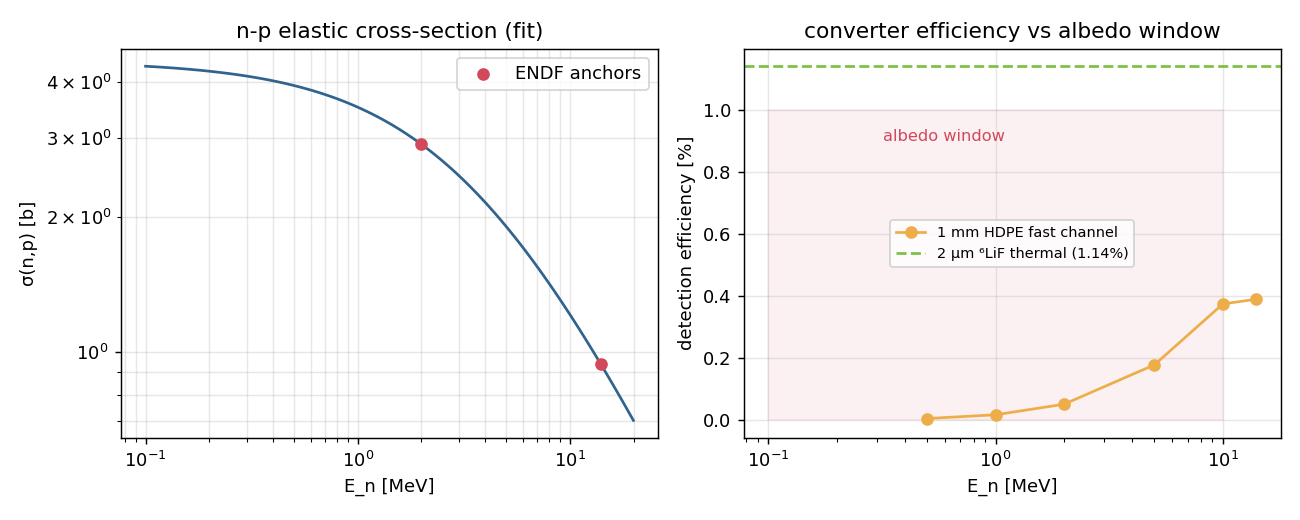
Neutrons have no charge and leave no track, so the tower carries converters: a bare reference layer, 1 mm of HDPE for fast neutrons by n–p recoil, and 2 µm of ⁶LiF for thermal capture. The efficiencies are small and honest — 0.02→0.39% across 1→14 MeV, 1.13% thermal — which against the Martian albedo band of 0.05 n·cm⁻²·s⁻¹ works out to 2.2 fast counts per hour and 86 thermal. Neutron spectra here are an hour-scale product, and the knowledge card says so.
The sentinels use 4H-SiC PiN diodes — the same epitaxial stack as an avalanche device with the gain implant left out. They can afford to: ⁶Li(n,α)t releases 4.78 MeV, and a 2.05 MeV alpha makes about 260,000 electron–hole pairs in SiC, two orders of magnitude above a MIP. Gain would only add noise. What the wide bandgap buys instead is silence. Generation current scales as n_i ∝ exp(−E_g/2kT), and 3.26 eV puts SiC roughly 18 decades below silicon: a silicon device on this fence would need cooling and light-tighting by 350 K, while SiC stays under 10⁻²⁰ A at 450 K and is blind to visible light for free.
The converter thickness is a genuine optimum rather than a maximum. Thicker ⁶LiF converts more neutrons but re-absorbs its own reaction products (alpha range 5.9 µm, triton 33 µm), so efficiency peaks at 4.72% at 29.9 µm and falls back to 4.0% by 60 µm. The design sits at 30 µm, on the flat.
The fence rate is not a guess either: it inherits the tokamak's own neutronics. A 2.271×10²⁰ n/s source at 640 MW fusion power, carried by the segmented Geant4 chain through blanket, shield, vacuum vessel, TF coils and cryostat to the cryostat exterior (r = 4.235 m), then through the declared 0.30 m of borated concrete to a cumulative escape of 1.164×10⁻¹⁰ per source neutron (registered target 1.92×10⁻¹⁰), and 1/r² over 58 m from the machine axis, arrives as 62.5 n·cm⁻²·s⁻¹ — the 2.32 counts/s the perimeter display actually shows. The earlier 2.15 n·cm⁻²·s⁻¹ → 0.08 counts/s sat behind a self-assumed 2 m shield and a 3.01×10²⁰ n/s source, both retired 2026-09-02; the chain's own qualifiers (per-join bias unapplied, chain reached 0.50 m at two records, resolved by a single-join probe) travel with the number.
Every number on this page, and the run that produced it. Two design ledgers, one table; scripts are deterministic and re-runnable.
| Claim | Value | Produced by |
|---|---|---|
| Weather mast — mars-weather, 14 accounts | ||
| Dust trip line for LEDs and no-fly | τ = 3 (2.7% direct) | mars-weather/sim_tau_retrieval.py |
| Optical-depth retrieval span / uncertainty | 5.1 decades · σ 0.011 | mars-weather/sim_tau_retrieval.py |
| Hot-film open-loop → CTA time constant | 17–48 s → 29.5 ms | mars-weather/sim_cta_response.py |
| CTA bandwidth at 5 m/s | 5.4 Hz | mars-weather/sim_cta_response.py |
| Film Nusselt number / velocity resolution | Nu 1.58 @ Re 6.7 · 0.13 m/s | mars-weather/sim_hotfilm.py |
| Cup start-up: Earth-standard vs oversized | 3.44 → 0.79 m/s | mars-weather/sim_cup_start.py |
| Wind-direction retrieval (MC, N=4000) | σ 1.4–1.8° | mars-weather/sim_wind_direction.py |
| Diaphragm thickness / deflection / sensitivity | 40 µm · 0.56 µm · 10.4 ppm | mars-weather/sim_baro_membrane.py |
| Intake pneumatic cutoff | 1.39 Hz | mars-weather/sim_inlet_filter.py |
| Warm-electronics-box night loss / heater / DoD | 27.3 W · 15.3 W · 22% | mars-weather/sim_cabin_thermal.py |
| Sun-tracking residual vs 2° field of view | 0.014° (70× margin) | mars-weather/sim_sun_tracking.py |
| Langley σ(I₀): hazy → stable → 4-morning | 5.9% → 1.5% → 0.73% | mars-weather/sim_sun_tracking.py |
| Night τ from stellar extinction (mV ≤ 3) | σ 0.003–0.01 | mars-weather/sim_skycam_imaging.py |
| Storm E-field ceiling (Paschen, CO₂ 610 Pa) | 28 kV/m | mars-weather/sim_efield_probe.py |
| Dust grain counting SNR / storm current mode | 625 · 41.7 nA | mars-weather/sim_dust_flux.py |
| Front vector from remote poles / warning lead | σ_v 4–5%, σ_az 2.2–2.8° · 1.2–3.7 min | mars-weather/sim_network_triangulation.py |
| Surface radiation station — mars_rad, 6 accounts | ||
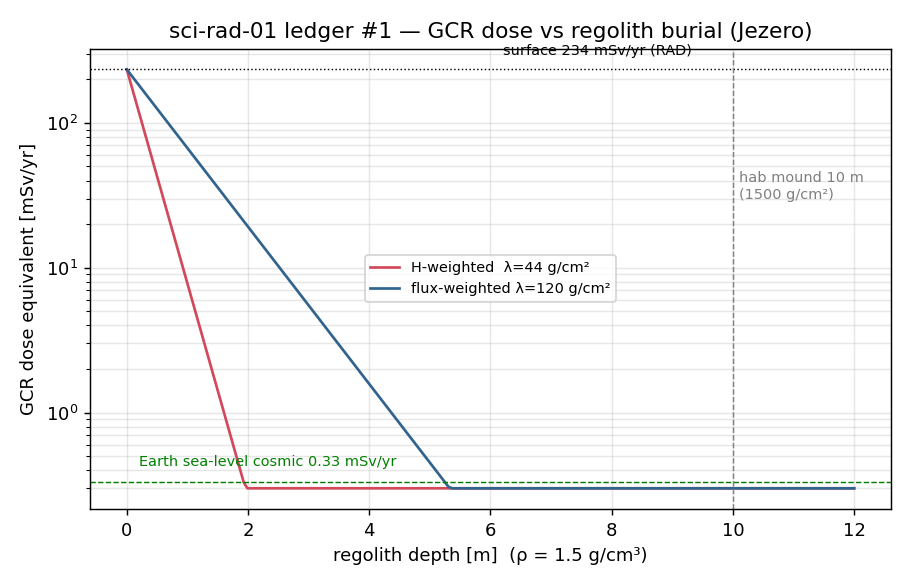
| Surface GCR dose equivalent | 0.66 mSv/sol · 234 mSv/yr | mars_rad/sim/01_dose_ledger.py |
| Dose e-folding depth (three-point closure) | λ_H 67 g/cm² | mars_rad/sim/01_dose_ledger.py |
| Residual dose under 10 m of regolith | 0.3 mSv/yr | mars_rad/sim/01_dose_ledger.py |
| MIP deposit vs digitiser threshold | 22.8 ke = 46× (11× worst) | mars_rad/sim/02_track_classification.py |
| LET ladder: electron → MIP p → 10 MeV p → Fe | 0.24 / 0.42 / 8.1 / 286 keV/µm | mars_rad/sim/02_track_classification.py |
| Converter efficiency: HDPE fast / ⁶LiF thermal | 0.02–0.39% · 1.13% | mars_rad/sim/03_neutron_response.py |
| Neutron channel rates vs albedo band | 2.2 / 85 counts·hr⁻¹ | mars_rad/sim/03_neutron_response.py |
| Worst-case SEP as fraction of readout ceiling | 1.7×10⁻⁴ | mars_rad/sim/04_sep_dynamic_range.py |
| Alarm thresholds on 1-min sliding count | green <3× · red >30× | mars_rad/sim/04_sep_dynamic_range.py |
| Frozen device point (bias / threshold / ENC) | 150 V · 500 e · 52.7 e | timepix4_allpix campaign (frozen checkpoint) |
| SiC sentinel net — mars_rad_sic, 5 accounts | ||
| ⁶LiF converter efficiency peak | 4.72% @ 29.9 µm | mars_rad_sic/design_rounds.py |
| Fusion-perimeter flux → count rate | CURRENT (dev/RULING_fence_with_reference_run.md, 2026-09-23; sentinel table chain4r, numeric-content sha256 67696b9b…9869, file b1fa57a0…3be8): rows 1–2 unchanged (0.657 cps as printed; 0.614, 0.439–0.877); joints 1–2 read by the long reference run (chain/reference 0.938 ± 0.066, COMPATIBLE_WITH_ONE, sci-rad-01 mars_rad a38611d) and carried at one measured factor in each direction (1.070 low-T, 0.821 high-T); joints 4–5 still placeholders; row 3, mixed load and requirement baseline, 0.434 cps (was 0.351); row 4, high-T placeholder load, 1.162 cps, for the red level's false-alarm side only. Change alarm: ×3 within 60 s met on the baseline (0.954, 52 s), missed at two statistical corners (68 s, 66 s) — accepted by the user on 2026-09-24, the alarm line unchanged. Yield-signal requirement 8% reading high / 12% reading low (replacing the interim 10% / 20%); red 14.7% high / 61% low. Both alarm levels remain design values. SUPERSEDED 2026-09-23 (dev/RULING_fence_on_chain4.md, 2026-09-21; sentinel table numeric-content sha256 0436abb9…3282, file 0b3f1025…8f2a; chain4, corrected launch, tokamak 9b74e12; read by sci-rad-01 mars_rad 6fc73b5 and reviewed dev/RULING_chain4_release_review.md): row 1, as printed and quotable, b not applied, T = 3.299e-11 → 0.657 cps; row 2, chain4's own b (+1.12 pp/join, governing σ 2.91, honest σ 0.84) on six joins, a side-by-side reading only since the concrete reading does not transfer, 0.614 cps, interval 0.439–0.877; statistical ±11.9% (Kish 71) a separate column; row 3, the mixed load and requirement baseline — concrete joint at b + 2σ = 6.95, vacuum-gap joint at 0 (identity by measurement), four joints without a reading at 15 — T = 1.764e-11 → 0.351 cps, a placeholder load, not a bound, one-directional by choice. F = 10⁴ reads ×14.4 / ×15.3 / ×26.1; ordering margin 332× / 310× / 177×. Margin of the 0.30 m face against the target 5.47× (4.42× at 2σ low); the 0.25 m face passes by rule at 1.22× and only 1.04× at 2σ low — the built thickness stays 0.30 m. Red 216 counts in any 60 s. Change alarm: sequential test; ×3 within 60 s is NOT met on the requirement baseline with a perfect signal (0.869, 64 s). Yield-signal design figure 10% high / 20% low, with no tolerance available to the unmet requirement; no interface is in force. Both alarm levels are design values. EVERYTHING FROM HERE TO THE END OF THIS CELL IS SUPERSEDED HISTORY (chain3, defective launch): 23.6 n·cm⁻²·s⁻¹ ±10.6% → 0.874 cps as printed by the delivery (T = 4.391e-11, machine geometry, tokamak a6cfb92 / corrections aeadc68; Kish N_eff 89 at the 0.30 m probe, used alone); 1.027 cps [row retired 2026-09-19] on sci-rad-01's shallow-probe reading (T = 5.157e-11 [row retired 2026-09-19] = 0.443 × the model value; a reading, not a finding — the probes share 644 parent histories; “conservative” for shield clearance, favourable for the fence); 2.02 cps [row retired 2026-09-19] if |b| sits at the registered limit of 15 pp/join with the sign unfavourable for the shield on all six joins (T × 2.31 — a test load, not a bound on T; b is unmeasured on this chain). Low side (T from sci-rad-01 mars_rad bb33e48; rates from the sentinel network mars_rad_sic 2296fc1, city 90c765b): 0.656 cps [row retired 2026-09-19] at T = 3.294e-11 [row retired 2026-09-19], if the model chain's measured b = +4.91 pp/join transferred (not established — that is the hold); 0.378 cps at T = 1.898e-11, the same limit-arithmetic with the other sign, conditional on |b| ≤ 15 pp/join exactly as the 2.02 row is. Across the five rows, high to low: F = 10⁴ reads as ×5.4 / ×9.6 / ×11.1 / ×14.4 / ×24.3 (×30.6 on the lowest with the statistical 2σ); F = 10³ as ×1.4 / ×1.9 / ×2.0 / ×2.3 / ×3.3; ordering margin 1022× / 519× / 442× / 331× / 190× (150× at 2σ); smallest leak at 5σ in 60 s ×1.75 / ×2.13 / ×2.24 / ×2.49 / ×3.13 — on the lowest row past the network's registered ‘> 3×: the integration window must be re-discussed’, recorded as open; the statistical ±10.6% (1σ) belongs to every row. Unrounded pedestal_total_cps and fusion_component_cps per row: mars_rad_sic/fence_bracket_under_hold.json. Ruled by the integrator 2026-09-19 (dev/RULING_fence_five_rows.md) and superseded the same day, when b was measured on chain3 (+5.57 pp/join, σ 3.01 as registered; condition (ii) SATISFIED, hold released, b not applied — sci-rad-01 mars_rad fc58520, reviewed dev/RULING_chain3_release_review.md): CURRENT TABLE (dev/RULING_fence_after_b.md; sentinel file sha256 e57a5968…88d7, city 41e9054) — row 1, as printed and quotable, 0.874 cps at T = 4.391e-11; row 2, chain3's own b over six joins, 0.632 cps at T = 3.172e-11, interval 0.453–0.898 cps (2.274e-11–4.512e-11), conditional on concrete's b holding on all six joins; the two are not merged, and the statistical ±10.6% is a separate column from the interval of b; row 3, 0.378 cps, a conditional test load and not a reading, not a requirement baseline. F = 10⁴ reads ×11.1 / ×14.9 (×10.8–×20.5 over the interval); ordering margin 442× / 319× (228× at the interval's low end); smallest leak at 5σ in 60 s ×2.24 / ×2.52. Red alarm 216 counts in any 60 s window; change alarm by sequential test, missing ×3-within-60-s at one corner (71 s on the binding baseline: every joint at its 2σ-high value, measured b + 2σ on the concrete joint and the pass limit on the unmeasured ones; dev/RULING_fence_after_b_addendum_mixed_load.md. ERRATUM 2026-09-20: that baseline was first computed on a split of two concrete joints and four others, T = 2.016e-11, 0.401 cps; the machine chain has one joint into concrete and five others, one of them into a vacuum gap that no cut family can measure, so the baseline is lower: T = 1.956e-11, 0.390 cps, the corner at 73 s (0.307 cps, detection 0.761) and the yield signal stable to 2% reading high / 5% reading low — a placeholder load, not a bound: five of the six joints have no reading, the limit taken for them says what a reading would have to meet and not what their bias is, and the joint into the vacuum gap is now known to carry a non-zero bias of unknown size (the re-launch turns every direction toward the wall normal, a defect of four lines of code found 2026-09-20; dev/RULING_fence_mixed_load_status_placeholder.md); the 71 s and the 3% below are superseded; dev/RULING_fence_mixed_load_M2j_provisional.md); the yield signal that would normalise it must then be stable to 3%; both design values — no fusion-yield signal exists to normalise by. The rows at 2.02, 1.03 and 0.66 cps are retired 2026-09-19. Before the measurement, none of these was the value: condition (ii) is not established on this chain, no RESOLVED verdict is printed, and the low side of T is unbounded (sentinel recompute mars_rad_sic a38ac7c, pre-registered 690be05, city 9ac7d92; sci-rad-01 mars_rad e1b4d40). Margin against the machine-radius target 1.8051e-10: 4.11× (3.39× at 2σ). Comparison at the interpolated minimum t = 0.253 m: 97.0 n·cm⁻²·s⁻¹ → 3.59 cps, by construction the target itself. Smallest leak resolved at 5σ in 60 s: ×2.24. Retired 2026-09-19: 62.5 n·cm⁻²·s⁻¹ ±3.3% → 2.32 cps ±3.3% (at 58 m from the machine axis, build thickness t = 0.30 m; escape value T declared pending re-derivation for the machine's radii, tokamak 15a89f01, 2026-09-12 — figure stands as printed until then); 103.1 n·cm⁻²·s⁻¹ → 3.82 cps at the interpolated minimum t = 0.282 m (comparison, not the build thickness) | mars_rad_sic/PREREG_perimeter_recompute_20260902.md — S_n = 2.271e20 n/s @ 640 MW × cumulative escape T = 1.164e-10 (0.30 m borated concrete, single-join probe from the chain's own source; registered target 1.92e-10; per-join bias b = +4.91% unapplied; the chain itself did not reach that thickness) / 4πr². The 62.5 is the chain's own escape number propagated to 58 m (sci-rad-01 reproduces it to 0.05%), not an independent check, and it inherits every qualifier of that escape value. Count rate computed by the sentinel response chain (A_pad / eff_fast / f_moderated / EFF_TH, intact; the 08-08 damage to design_rounds.py lost account-2 outputs and prose, since rebuilt as RESOLVED_* keys) and cross-checked by the linear rescale of the old 0.08 cps @ 2.15 point (2.33). Standing qualifier: the chain's two spectral parameters (f_moderated = 0.35, eff_fast = 0.002) were calibrated on the spectrum behind the self-assumed 2 m ordinary concrete; the spectrum behind 0.30 m borated concrete differs and the SiC response is energy-dependent, so those two parameters await re-calibration. Void and recompute if the build thickness departs from 0.30 m or the escape value is revised. The earlier 2.15 → 0.08 cps was a self-assumed 2 m / TVL 0.25 m shield, never a bound. Build thickness declared by the tokamak 2026-09-02: 0.30 m = the measured face, not the 0.282 m interpolated minimum (margin 1.65×; z-end leakage, duct streaming and groundshine are not covered by any thickness and sit in other ledgers); leakage chain: dev/PREREG_fusion_leakage_reading_rule.md |
| Foyer tier: 30 m rock, muon residual | 52 e-foldings · 83 s/count | mars_rad_sic/design_rounds.py |
| Deep tier: muons ×10⁻⁶, radiogenic floor | ~26 days/count | mars_rad_sic/design_rounds.py |
| SiC vs Si generation current at 300 K | 9×10¹⁷ ratio · <10⁻²⁰ A at 450 K | mars_rad_sic/design_rounds.py (LGAD L2a TCAD anchor) |
Cross-checked, not coincidental. Two numbers on this page are shared across ledgers on purpose. The albedo-neutron band of 0.05 n·cm⁻²·s⁻¹ appears in both the surface station's converter ledger and the SiC depth ledger — agreeing only because the first one was corrected to match (see below). And the perimeter count rate inherits the fusion plant's own Geant4 neutronics rather than assuming a leakage figure.
Six real ones, from both ledgers — three physics traps, three that were the renderer lying to us.
The draft used a broadband 5 n·cm⁻²·s⁻¹ albedo figure. Cross-checking against the sibling SiC ledger forced a re-anchor to the RAD-derived fast band, 0.05 n·cm⁻²·s⁻¹. Fast-channel counts fell from per-second to 2.2 per hour. The knowledge card now says spectra arrive on the hour scale instead of pretending otherwise — and the agreement between the two ledgers quoted above exists because of this correction, not despite it.
The first barometer capsule used an 18 µm silicon membrane, which deflects 6.2 µm at 900 Pa full scale — straight through the 2 µm capacitive gap. Since deflection goes as 1/t³, thickening to 40 µm brings it to 0.56 µm with sensitivity to spare: 0.1 Pa still maps to 10.4 ppm of capacitance.
Wrapping the full 6.8 m² equipment cabin in 4 cm of aerogel still leaks 128 W on a −80 °C winter night — unaffordable on a solar-charged battery. The answer was to stop heating the cabin and heat a box inside it: a 2.88 m² warm-electronics box with 6 cm of aerogel leaks 27.3 W, needs a 15.3 W heater, and lands at 22% depth-of-discharge by dawn. The cutaway geometry in the city shows that pivot rather than the first design.
The Langley Monte Carlo was supposed to confirm the 1% calibration term. It returned 5.9% instead — because τ itself drifts during the morning sweep, and that drift, not radiometric noise, dominates. Re-running in two drift regimes produced the procedure that actually ships: screen for stable mornings (1.5%), then average four of them (0.73%).
The green alarm segment's Lambert diffuse made it read as lit in daylight even at zero emissive — an indicator that cannot indicate. The same failure washed the track-screen glyphs white under the night floodlight. Fix: near-black diffuse on every display element, with all colour carried by emissive alone, so an unlit lamp is unambiguously unlit.
The headless GIF capture returned an entire recording of blank frames — the same failure the sibling session had already logged, so it cost two sessions before the tool was abandoned. Replaced with a deterministic visible-page capture stepped through the pure-t supercycle and assembled with ffmpeg: identical output on every run. The weather station hit a cousin of this one, where captures taken in a hidden tab silently froze every animation because the browser suspends the frame loop.
Both stations animate in the city viewer, and both loops are deterministic — the same t always gives the same frame.
Orbit the mast. Walk close and the bilingual knowledge cards surface — eight of them, seven carrying the simulation that produced their numbers.
The track screen and the alarm tower. Watch a curl, a bar and a blob and you have read the classification table off the glass.
Both stations sit on the north-east highland, deliberately clear of buildings — a mast in a wind shadow measures the buildings, not the weather.
Find the sentinel post against the cavern wall. Its display is the one that should never change.