The buildings that came after the city could feed itself. A free-electron laser tunable from 10 to 150 micrometres, a cryo-EM laboratory buried 30 m down because rock is quieter than any isolation table, a sulfur plant whose real product turned out to be oxygen, the life-support pair that closes water at 98.2%, and a launch campus that assembles its rockets lying down.
Everything on this page exists because something else in the city stopped being the bottleneck. None of it would have been built first.
A colony still proving it can breathe does not build a free-electron laser. These five sites are the second wave — the ones that assume power, water and air are solved, and spend the surplus on measurement, on materials, and on getting mass off the ground.
They are also where the design ledgers ran longest, and where they most often argued against their own brochures. The FEL accumulated 42 ledgers, 105 known-answer gates and 69 logged pitfalls across twenty-four review rounds, and spent most of them talking itself down: a 50 MeV nameplate became 37.0 MeV, a 5 micrometre short-wavelength edge became 10. The sulfur plant discovered its real product was not sulfur. The assembly hall was redesigned from vertical to horizontal after someone compared its roofline against the tallest building in the city.
Five mechanisms, and for each the one constraint that shaped the geometry.
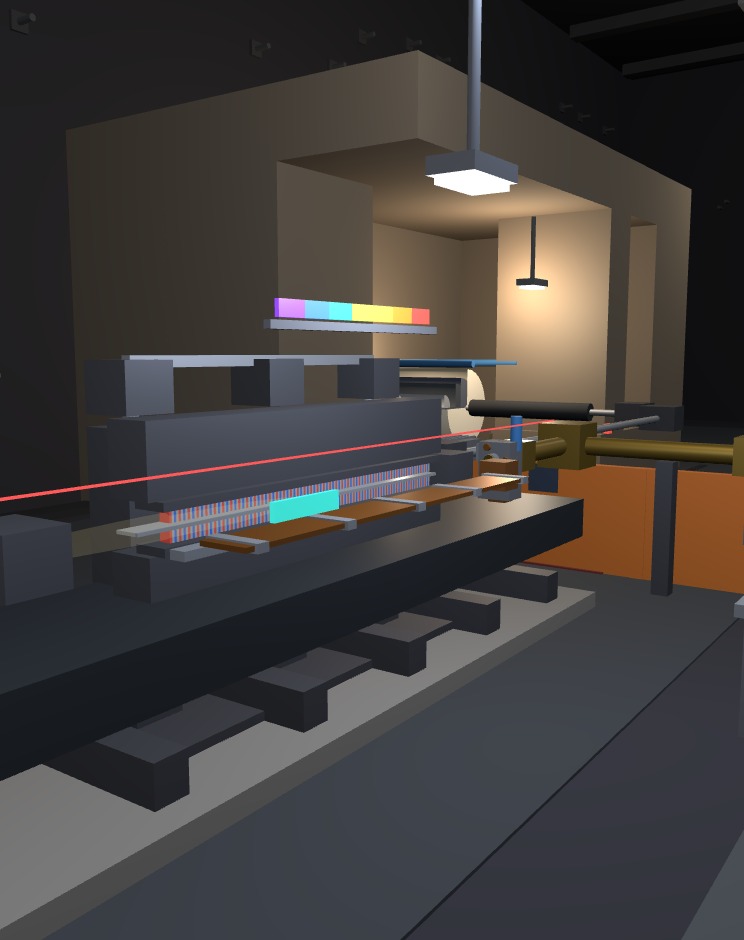
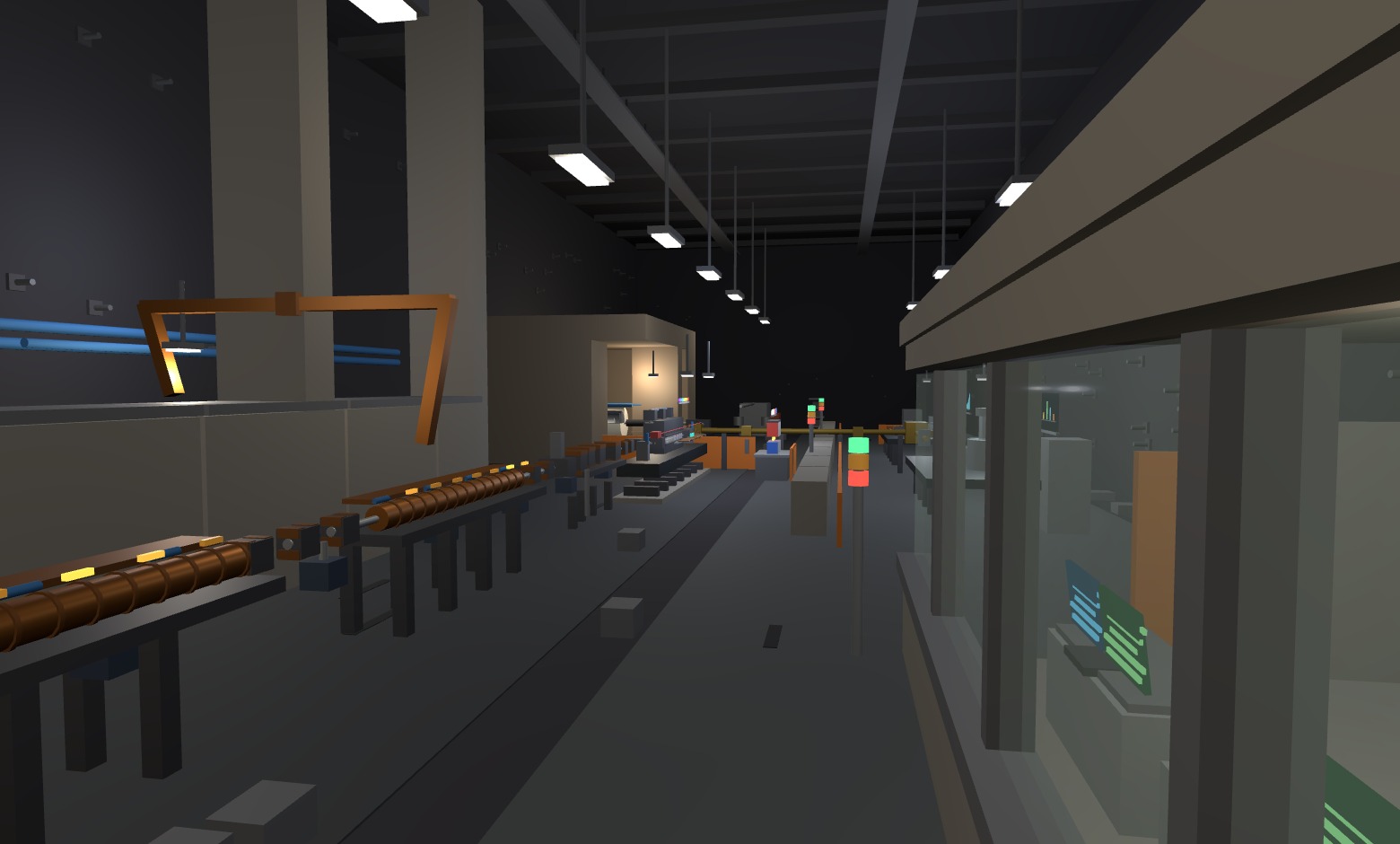
A free-electron laser has no gain medium. A 37 MeV electron beam is wiggled through 40 periods of a 65 mm permanent-magnet undulator, and the light it emits is set by geometry alone: lambda equals lambda-u over 2 gamma squared, times (1 + K squared over 2). Change the beam energy or open the magnet gap and the colour moves. The published band is 10 to 150 micrometres — continuously tunable across a 15:1 range that no benchtop source spans.
Why not an X-ray FEL? Because 1.5 Angstrom light needs 13.6 GeV, which at room-temperature copper gradients is a 1.7 km machine, and the superconducting alternative needs tonnes of liquid helium. Mars air holds 4 ppm helium: extracting one tonne means processing 1.8e11 cubic metres of atmosphere. That single line vetoed the entire superconducting route, and the infrared machine that survived fits in a 56 by 20 by 12 m cavern and draws 74 kW — 0.042% of the city grid.
The optical cavity is 6.00 m of near-concentric gold mirrors with a hole for out-coupling. The accelerating structure is 1.0 GHz travelling-wave copper, whose shunt impedance was measured in a full-wave eigenmode solve rather than quoted: 37.5 MOhm/m, plus or minus 5%.
Two capabilities on this machine cannot be reproduced by a benchtop source, and both were found late, by running virtual experiments rather than by quoting a brochure. The first is site-selective pumping: nitrogen donors in 4H-SiC sit at 60 and 100 meV, which is 20.7 and 12.4 micrometres, both inside the band and resolvable by the monochromator. The second is peak field: 14 mJ/cm2 in a 0.85 ps micropulse is 1.5e10 W/cm2, or 341 MV/m — 34 times the field-induced transition threshold of vanadium dioxide, which puts a genuinely non-thermal phase transition inside reach. The same number is a warning: it is 114 times the breakdown field of air, so every dielectric part near the focus must be designed for high field.
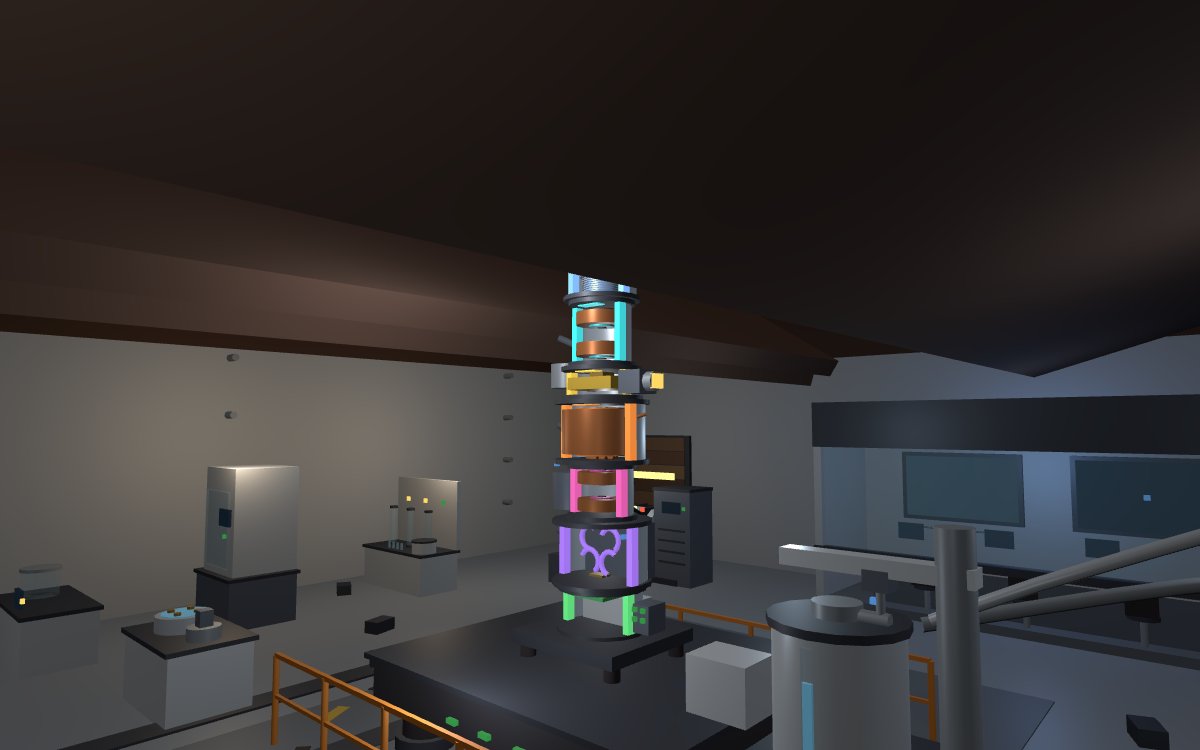
A 300 kV electron has a wavelength of 1.9687 pm — about a hundredth of an atom. The limit is never the wavelength; it is spherical aberration, and the column's Cs of 3.32 mm was computed here by an in-house field solver plus ray tracing, giving a Scherzer point resolution of 2.63 Angstrom and an information limit of 1.51 Angstrom. Routine delivery on a moderately heterogeneous complex is 2.5 Angstrom; well-behaved symmetric samples reach 1.8.
To hold that, the column and stage must not move relative to each other by more than 30 pm rms between 16 and 1000 Hz. The city's own vibration specification is 1.2e-6 m/s/sqrt(Hz) at 10 m, which on a bare floor lands at 47,364 pm — a factor of 1579, or 64 dB, too loud. Three passive stages (1.5 Hz air legs, an 8 t granite block at 4 Hz, in-column mounts at 8 Hz) bring it to 13.3 pm.
But vibration is only the second reason this laboratory is 30 m down. The first is temperature: basalt's diurnal thermal skin depth is 0.156 m and its annual depth 4.04 m, so at 30 m the surface's 60 K swing is simply gone. The resulting stage drift is 2.85e-2 nm/min, 2.8% of spec — 35 times better than a surface room.
Two Mars-specific consequences follow. The instrument's boil-off nitrogen, vented without a thought on Earth, is here 56% of the colony's entire buffer-gas loss; recovering it costs 1.23 kWh/kg against 8.49 to vent and remake. And every Martian sample must pass a perchlorate bench first — not for cleanliness but because magnesium perchlorate brine reaches exactly the 1.35 g/cm3 density of protein at 35 wt%, at which point contrast vanishes entirely.
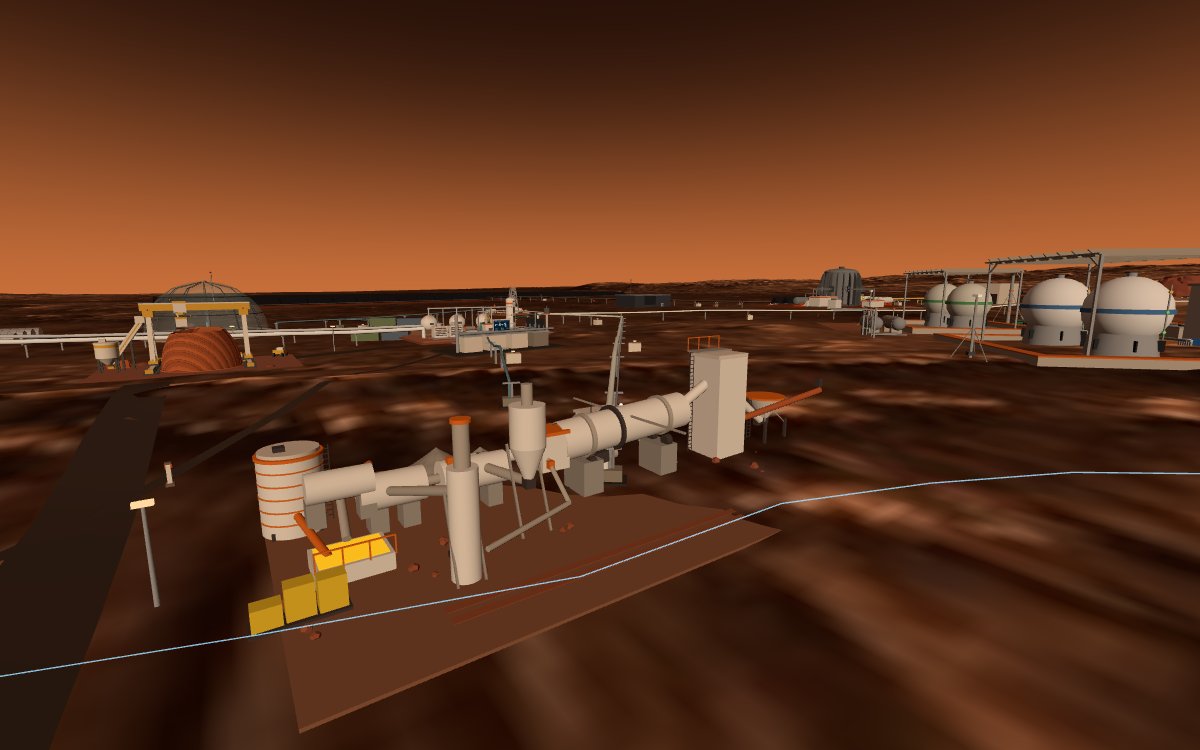
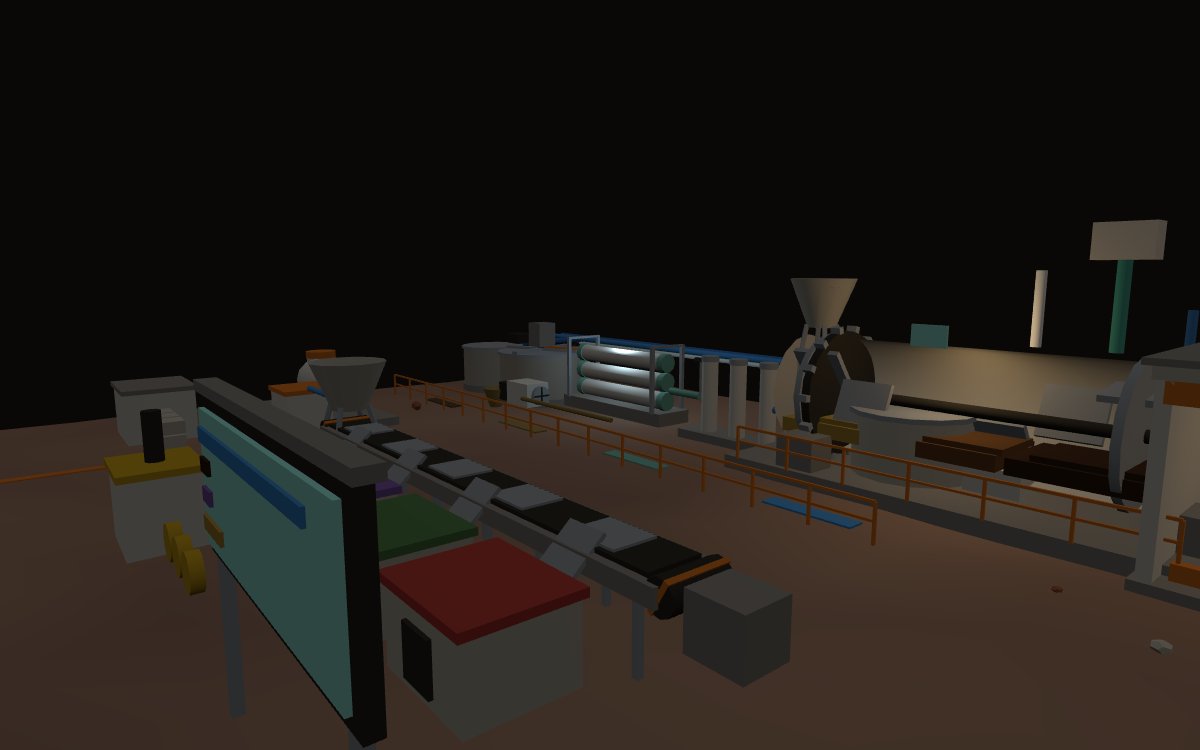
A rotary kiln 1.3 m across and 11 m long, inclined 4 degrees and turning at 1.5 rpm, roasts sulfate-rich regolith at 900 C in a reducing atmosphere. Hydrogen strips oxygen from the sulfates to make calcium sulfide and water vapour; two Claus converters then recover elemental sulfur at about 97% per pair. Output is 100 kg of sulfur per sol for 63 kWe, or 0.016% of the city's power.
The hydrogen is circulated, not consumed, and the oxygen it strips is finally released in the ISRU electrolyser. That is where the plant's identity flips: every kilogram of sulfur liberates two kilograms of oxygen, so the site quietly delivers 200 kg of O2 per sol while consuming zero water. On the balance sheet it is an oxygen plant that happens to leave sulfur behind.
The other lever is grade, and it is brutal. Producing 1 kg of sulfur means processing 1/(grade times recovery) of ore: 11 kg of the 10 wt% horizon, but 46 kg of ordinary 2.4 wt% soil. Same kiln, same kilowatt, 4.2 times the throughput. Selective bench mining upstream is the cheapest step in the entire chain, and the kiln diameter, the feeder and the whole sensible-heat ledger are all sized off it.
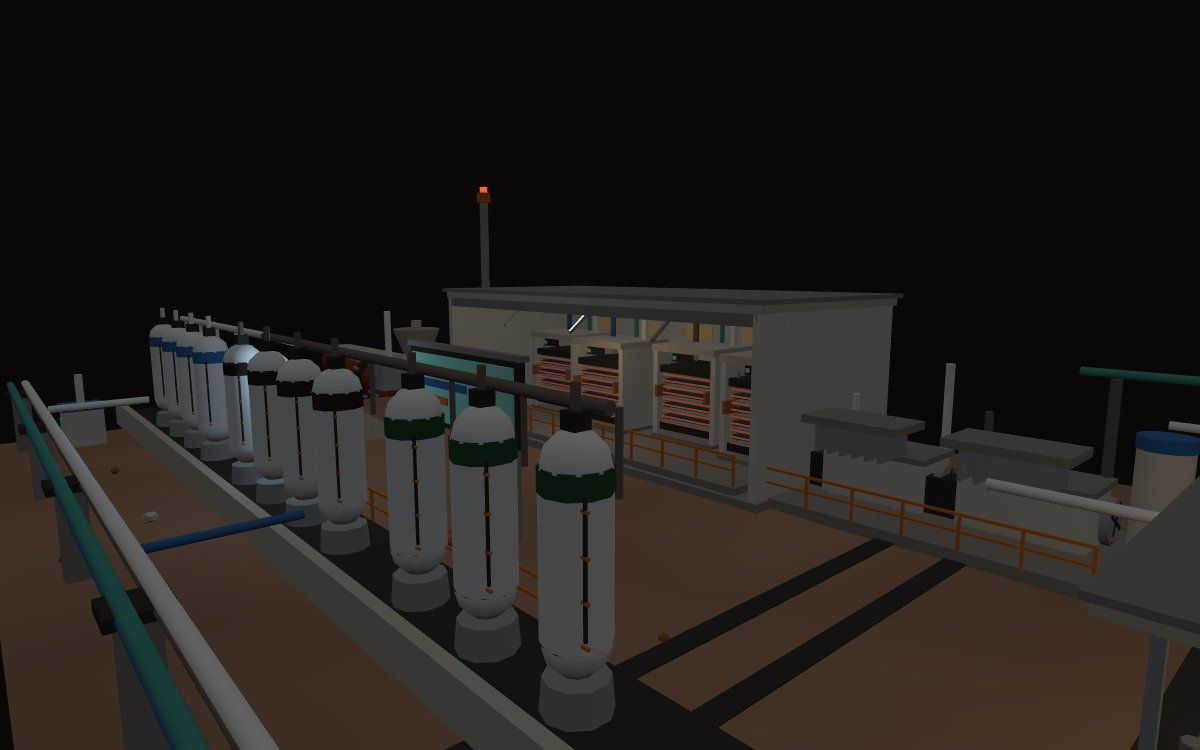
These two buildings are the city's arithmetic made physical. A population of 115 — derived from a watch bill, post by post, across every delivered asset — breathes 99.1 kg of oxygen and exhales 118.0 kg of carbon dioxide per sol. Four electrolyser modules answer the first number: two steam SOEC stacks at 4.84 kWh per kg of O2, and two CO2 SOXE stacks, fed on raw Martian atmosphere at 5.60 kWh per kg and no water at all.
The cheapest oxygen in the city, though, comes from a small branch at the west end. Heating magnesium perchlorate to 350–450 C decomposes it exothermically into magnesium chloride and four molecules of O2 — 0.573 kg of oxygen per kg of salt for a marginal 0.24 kWh per kg. The soil's most notorious poison is also its most efficient oxygen warehouse.
What actually costs is buffer gas. Martian atmosphere is 95.1% CO2 and only 2.6% nitrogen, so it takes 29 kg of atmosphere per kg of buffer gas, at 5.27 kWh/kg — the same order as oxygen. That is why the cabin runs a 58/42 nitrogen-argon blend rather than pure nitrogen, and why an airlock retrofit that cuts loss from 181.8 to 66.1 kg/sol is worth a whole ledger.
Next door, water. The recycling plant takes 659 kg/sol of urine, condensate and greywater and returns 647 — 98.2% closure — leaving just 30.3 L/sol of make-up drawn from the Rodwell well, which is 8.0% of it. (ISRU propellant hydrogen takes 50.8%; life support is not what strains the well.) Solid waste goes to zero landfill: plastics pyrolysed to printer filament, textiles shredded as compost bulking, 93.8 kg/sol compacted into the habitat berm as shielding.
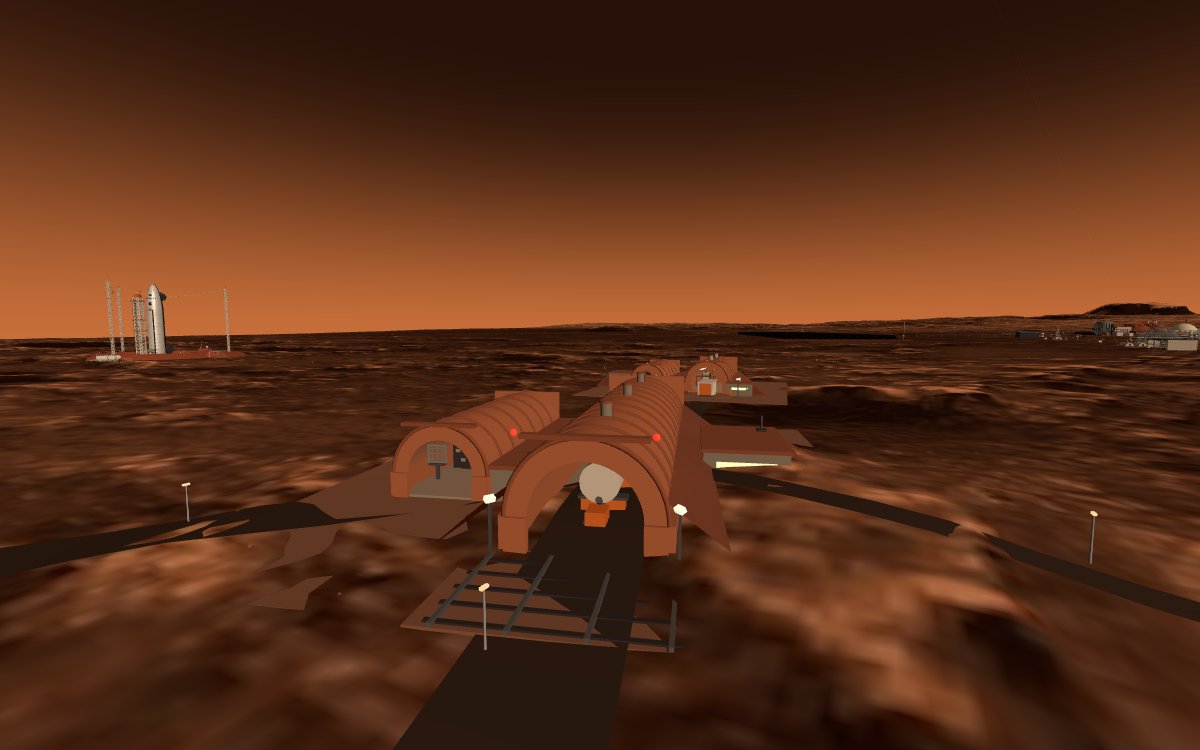
The rocket is 67 m long. Assembling it vertically would require an 86 m building — in a city whose tallest structure is 20 m. So the hall is a sintered-brick barrel vault, 16 m span, 12.2 m high, 72 m long, and the rocket is built horizontally, lying on the erector-transporter it will ride to the pad.
The vertical work that genuinely needs height already exists 170 m away: the launch complex has an 85 m service tower with five rotating platforms. Building a second tower would have been pure redundancy. Assemble horizontally, transport horizontally, raise at the pad — the same reasoning Falcon 9 and Soyuz arrived at.
The choice propagates. The erector's 62 m beam needs only 6 m of clearance along the route, against the 100 m class a vertical mobile platform would demand. Next door, the payload building encapsulates fairings horizontally too, so its clear height is set by the 5.2 m fairing diameter rather than its 12.5 m length: 10.6 m instead of thirty-something. The vault is buttressed by earth berms, because an arch converts load into thrust along its axis and that thrust has to be resisted — and the same berm gives the walls thermal mass against a 60 K diurnal swing.
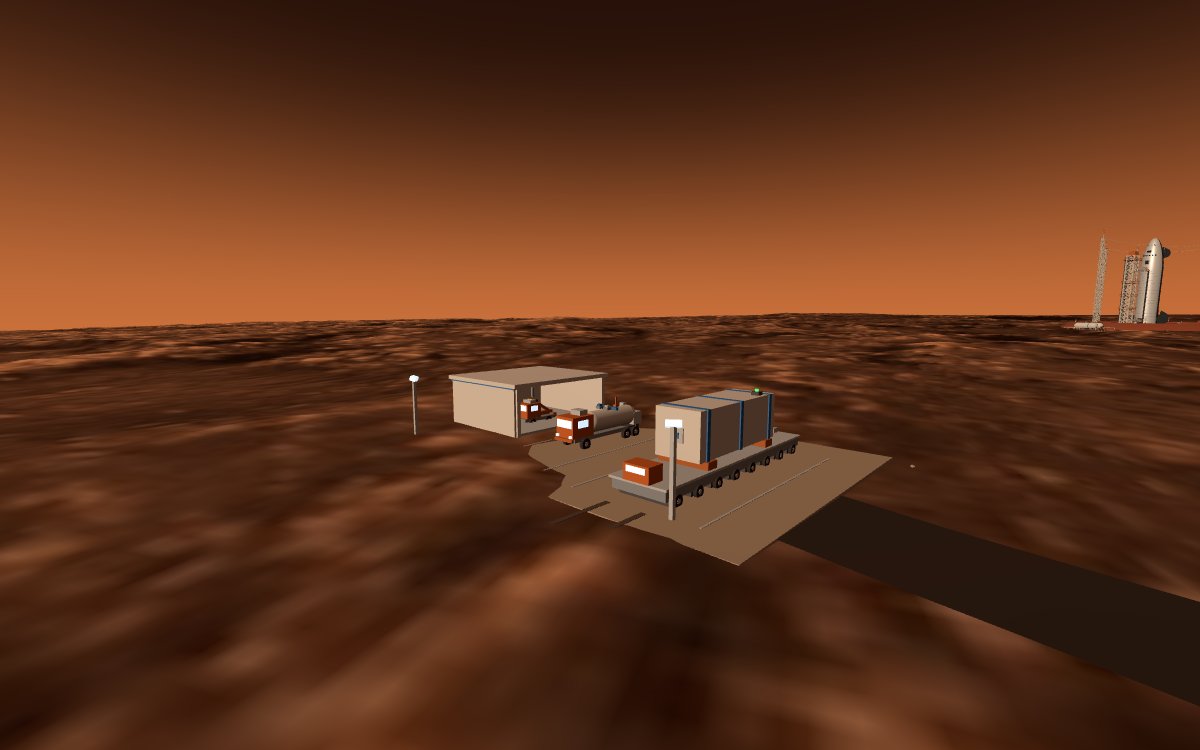
On the ground between them runs the only fleet in the city that can move big things: an eight-axle-line modular transporter with a 24 m deck, each line independently levelling so a 5 m diameter stage crosses uneven apron without racking, and a vacuum-jacketed tanker whose 12.8 m3 vessel carries 14.6 t of liquid oxygen or 5.4 t of methane — the same tank, a different placard. Its vapour-return hose alone saves 79 kg per trip.
Every headline number on this page, and the run that produced it. Nothing appears above without a line here.
| Claim | Value | Produced by |
|---|---|---|
| FEL tuning band, twice revised down | 10–150 um | mars-fel/sim/19_multiwavelength.py, 20_injector_transverse.py |
| Beam energy ceiling, two independent methods | 37.0 MeV | mars-fel/sim/21_structure_em.py, 23_periodic_cell.py |
| Shunt impedance, eigenmode solve | 37.5 MOhm/m ±5% | mars-fel/hfss/23_single_cell.py |
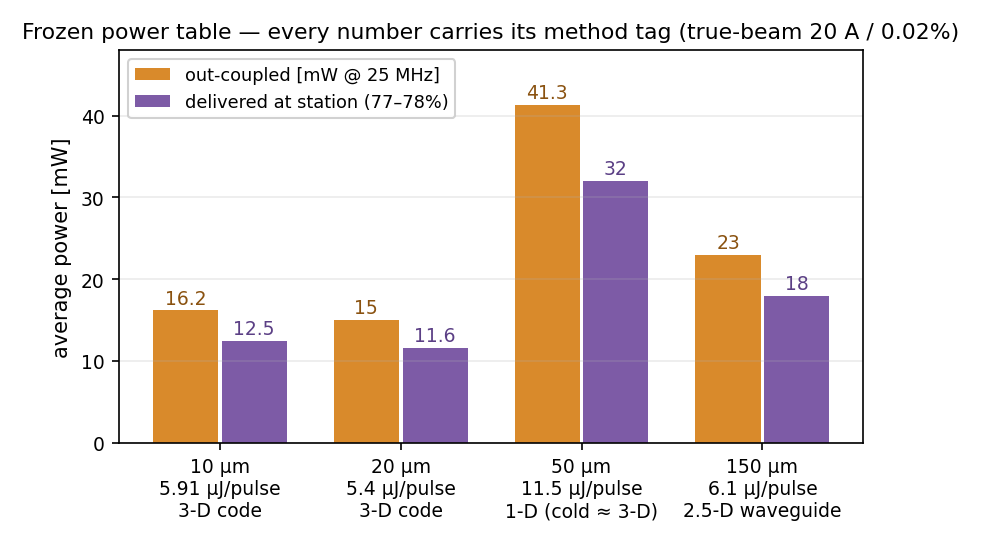
| Out-coupled pulse energy, four bands | 5.91 / 5.4 / 11.5 / 6.1 uJ | mars-fel/sim/22_seeding.py, 24_waveguide_3d.py |
| Delivered at station after transport | 12.5 / 11.6 / 32.0 / 18.0 mW | mars-fel/sim/31_transport_mono.py |
| Micropulse peak field | 341 MV/m | mars-fel/sim/40_run_bl2_vo2.py |
| LLRF closed-loop bandwidth, delay-limited | 10 kHz | mars-fel/sim/42_llrf_loop.py |
| Perchlorate detection limit, spectroscopy station | 0.022 wt% | mars-fel/sim/07_users.py, 32_bl1_spectroscopy.py, 36_run_bl1_perchlorate.py |
| Implant-damage trap density, SiC wafer QC | 2.0e17 cm-3 | mars-fel/sim/37_run_bl2_sic_traps.py |
| Facility electrical load, share of city grid | 74 kW = 0.042% | mars-fel/sim/04_accelerator.py |
| Shielding stack, Geant4 sign-off | 11.95 tenth-value layers | mars-fel/g4 (Geant4 11.2.2), sim/18_geant4_signoff.py |
| Cryo-EM Scherzer resolution, in-house solver | 2.63 A | sci-cryoem-01 card, ledger 10 |
| Routine delivered resolution | 2.5 A | sci-cryoem-01 card, ledger 12 |
| Detector DQE(0), counting mode | 0.91 | sci-cryoem-01 card, ledger 14 |
| Vibration attenuation required | 1579x = 64 dB | sci-cryoem-01 card, ledger 3 (city spec from sci-seis-01) |
| Stage motion after three isolation stages | 13.3 pm rms | sci-cryoem-01 card, ledger 3 |
| Liquid nitrogen draw, share of colony loss | 27.3 kg/sol = 56% | sci-cryoem-01 card, ledger 4 |
| Contrast-null brine concentration | 35 wt% (1.35 g/cm3) | sci-cryoem-01 card, ledger 7 |
| Sulfur output and its oxygen co-product | 100 / 200 kg per sol | res-sulfur-01 card, plant ledger |
| Ore-grade lever, high-grade vs ordinary soil | 11 vs 46 kg per kg S | res-sulfur-01 card, grade ledger |
| City population, from a watch bill | 115 | res-eclss-01 card, staffing model |
| Oxygen energy cost, SOEC and SOXE | 4.84 / 5.60 kWh per kg | res-eclss-01 card, electrolyser ledger |
| Perchlorate-route oxygen, marginal energy | 0.24 kWh per kg | res-eclss-01 card, perchlorate branch |
| Buffer gas per kg, atmosphere processed | 29 kg at 5.27 kWh/kg | res-eclss-01 card, intake ledger |
| Airlock loss before and after retrofit | 181.8 → 66.1 kg/sol | res-eclss-01 card, airlock ledger |
| Water loop closure | 98.2% | res-recycle-01 card, water ledger |
| Well make-up, share of the Rodwell | 30.3 L/sol = 8.0% | res-recycle-01 card, water ledger |
| Assembly hall span and rocket length | 16 m span / 67 m rocket | ops-vab-01 card, main-vault ledger |
| Vertical-assembly building that was avoided | 86 m (city max 20 m) | ops-vab-01 card, configuration trade |
| Route clearance, erector vs vertical platform | 6 m | ops-vab-01 card, erector ledger |
| Payload hall clear height, horizontal encapsulation | 10.6 m | ops-payload-01 card, fairing ledger |
| Tanker capacity, one vessel two services | 14.6 t LOX / 5.4 t LCH4 | veh-ground-01 card, ledger 3 |
The rounds these five sites spent disagreeing with themselves. Most of the interesting numbers on this page are the second or third answer, not the first.
The first ledger published 5–150 micrometres. Ledger 19 ran the true beam through a time-dependent oscillator code and found 5 um would not lase at all — band edge moved to 6.5. Ledger 20 then checked whether the 50 MeV needed for the short edge was actually affordable, found it was not, and the edge moved to 10 um. Neither revision came from a reviewer; both came from this project's own gates.
Ledger 21 discovered that the accelerator ledger had omitted the travelling-wave feed efficiency term entirely — while simultaneously under-estimating shunt impedance. The two errors nearly cancelled, which is the most dangerous kind of agreement. Only a full-wave eigenmode solve separated them, and the energy ceiling settled at 37.0 MeV.
Ledger 31 quoted a differential-pumping pressure ratio of 2.3e4. Three rounds later, ledger 34 rebuilt the same calculation from a vacuum network model and got 280. The original had mis-recorded a single-stage ratio as 1/153 instead of 1/15.3; squaring it for two stages inflated the answer a hundredfold. The verdict — windowless differential pumping — survived; the comfortable margin did not.
The thin-film metrology code paired a Lorentz oscillator with a transfer matrix and got a transmittance of 1.09 — energy from nowhere. The sign convention of the complex refractive index has to match the propagator form, and it did not, so absorption came out as gain. Nothing threw an exception; the first-pass conclusion "thinnest measurable film: 100 nm" was simply wrong. An energy-conservation gate now runs before anything else in that code.
The LLRF loop was first judged against the textbook 45–70 degree phase margin. That rule describes second-order systems; a delay-dominated loop sits above 100 degrees naturally, and applying the rule emptied the entire candidate table. The real constraint is gain margin, and once that was used the bandwidth ceiling — 10 kHz, set by the structure's filling time rather than by any electronics — fell out immediately.
A systematic offset in the perchlorate inversion was blamed first on slow drift, then on a collinear mineral component. A two-way table with both suspects switched off still showed the offset — which meant neither was responsible. The real cause was that the design matrix's baseline columns had never been passed through the instrument function. Keep the control cell.
Sized, costed and named around 100 kg of sulfur per sol, the site's own mass balance showed the hydrogen circuit liberating twice that mass in oxygen, at zero water cost. The product that justified the building turned out to be the by-product of the one that pays for it.
The Rodwell well had sized water for four people, the sulfur plant oxygen for four, and the berm village listed 28–32 berths. Nobody had reconciled them. A watch bill built post by post across every delivered asset produced 115, of whom 30 live in the village — inside its stated range, and now the single number every life-support card cites.
The first configuration assembled the rocket vertically. Then someone put the required 86 m building next to the tallest structure the city actually has, which is 20 m — and noticed the launch complex already owns an 85 m service tower 170 m away. The hall became horizontal, the payload building followed, and both lost two thirds of their height.
The recycling plant bales 20 kg/sol of scrap metal and stacks it by alloy grade under a sign reading "awaiting melt". The city has no smelter. Rather than book the stream as recovered material, the ledger books it as what it is — sorted, decontaminated inventory waiting for an asset that does not exist yet.
All five sites are in the city model. Two are interiors you enter; the rest you walk up to.
Open the viewer and use the district links, or jump straight in. The FEL and the cryo-EM laboratory are underground interiors reached through their surface entrances; the sulfur works, the launch campus and the ground fleet sit on the surface east and south-east of the main habitat cluster.