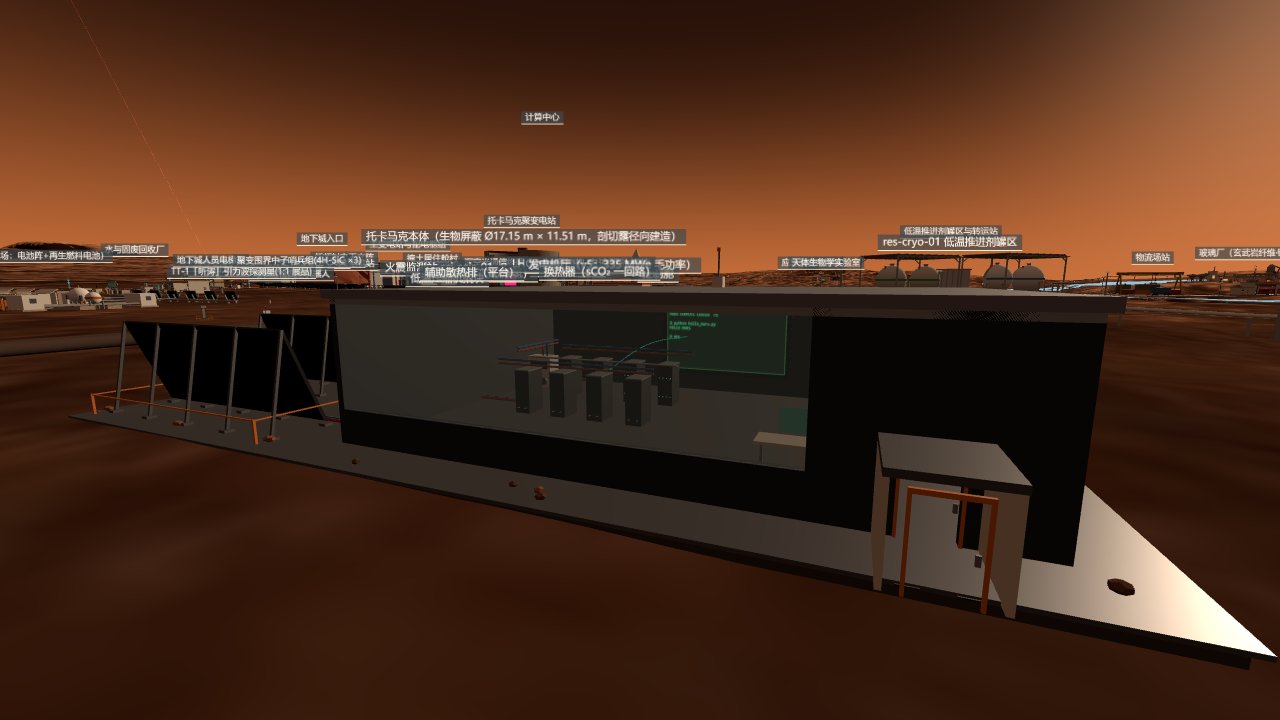
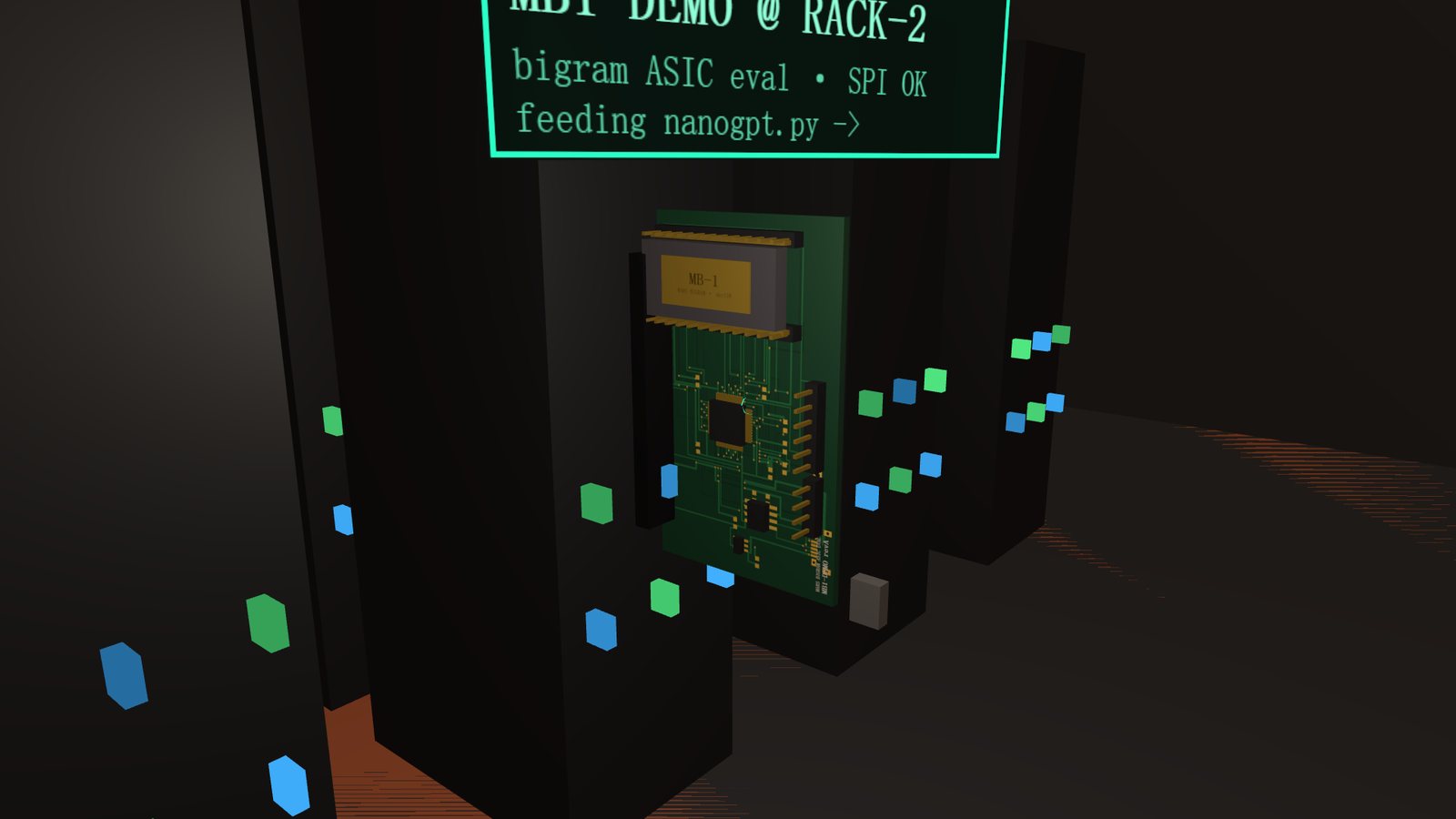
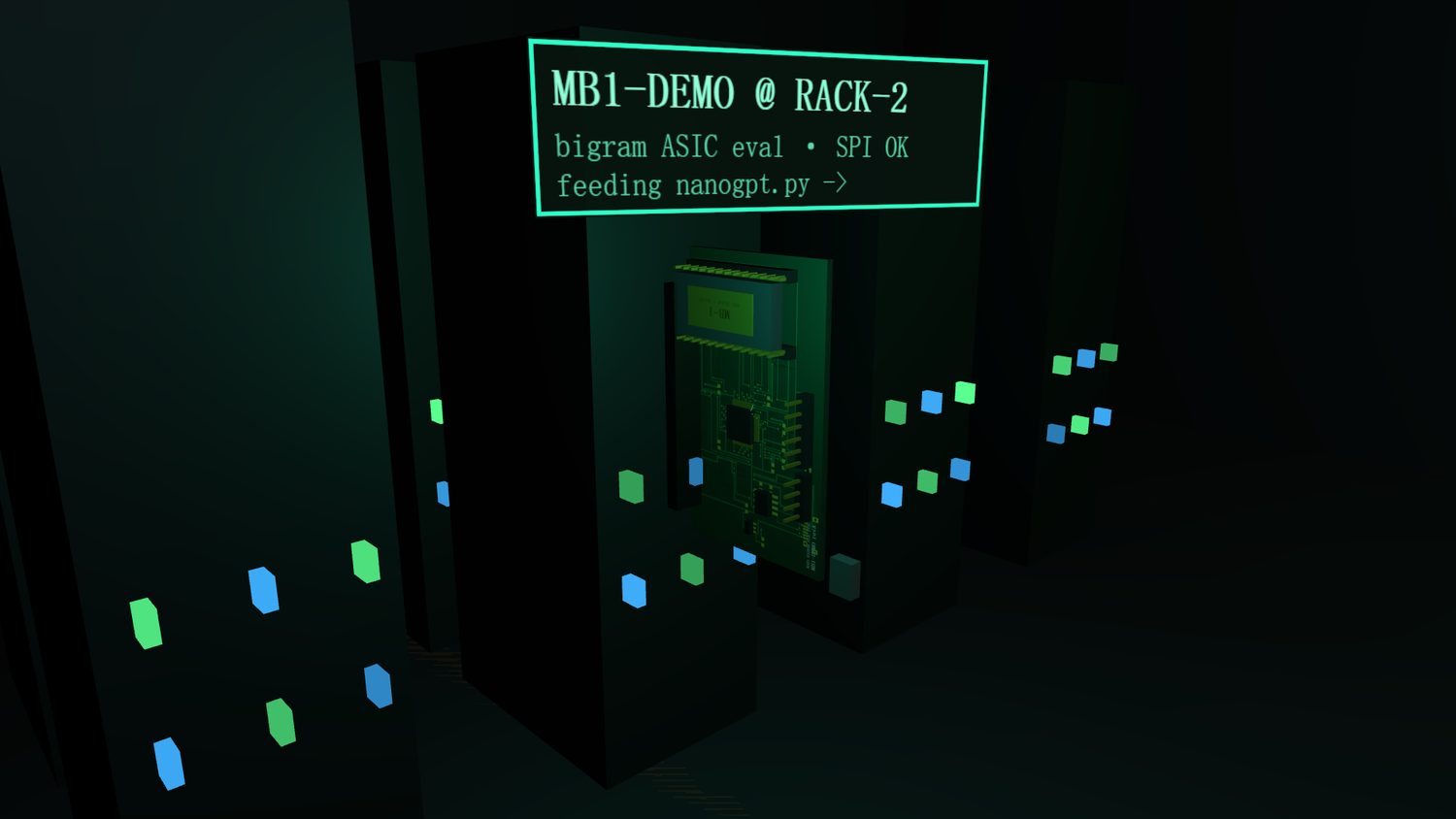
The compute center is where the whole city closes its loop. Since this round the big screen runs the MB-1 algorithm itself, bit-exact — same LFSR, same clamped inverse-CDF walk, same 4096-word table — and self-tests against the Python golden on boot. MB-1 was taken from Verilog to a sky130 GDS. No silicon exists and the evaluation board was designed but never ordered; the page says so. And the room around them is now a room that can be accounted for on Mars: six ledgers size its racks, its cooling loop, its radiator field, its feeder, its data link, and say what they cannot close.
A datacenter hall whose hero screen runs an AI — the AI's silicon body is designed one rack over — and every wall, panel and pipe now has a number behind it.
The big screen types Mars text character by character. In v0 it ran a bigram of the same class as the chip's,
counted live in the browser with Math.random(). That sentence on the old card — "the same algorithm as the wall
display" — did not survive this round's audit, so the screen was changed rather than the card: it now imports the chip's
own CDF table (mb1-cdf-data.js, generated from build/mb1_cdf.mem), runs the chip's arithmetic, and
prints MB-1 bit-exact vs python golden: PASS in its boot log. If that line ever reads FAIL it is red.
The table is trained on the city's own seven Mars sentences, which are now also MB-1's training corpus.
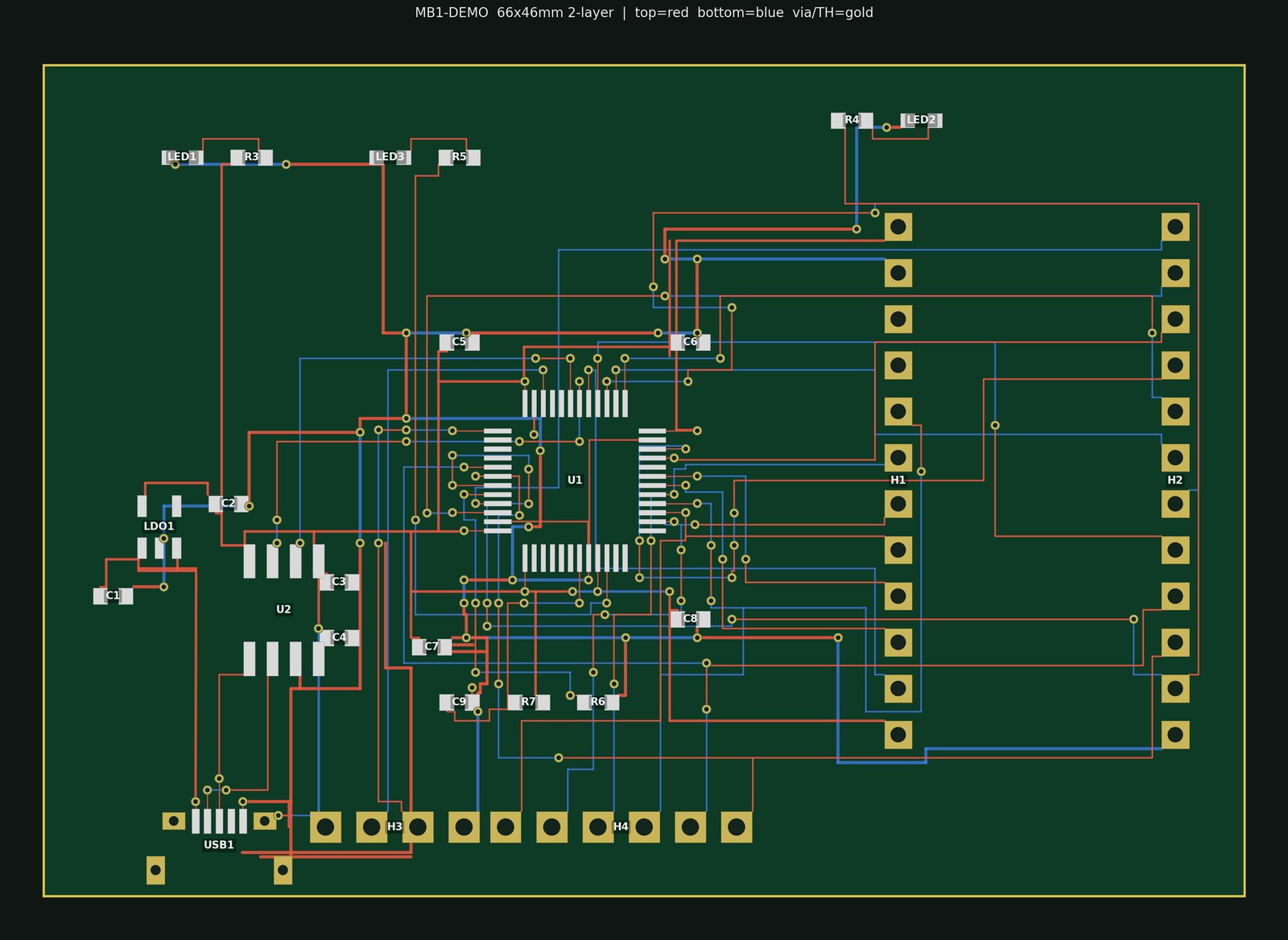
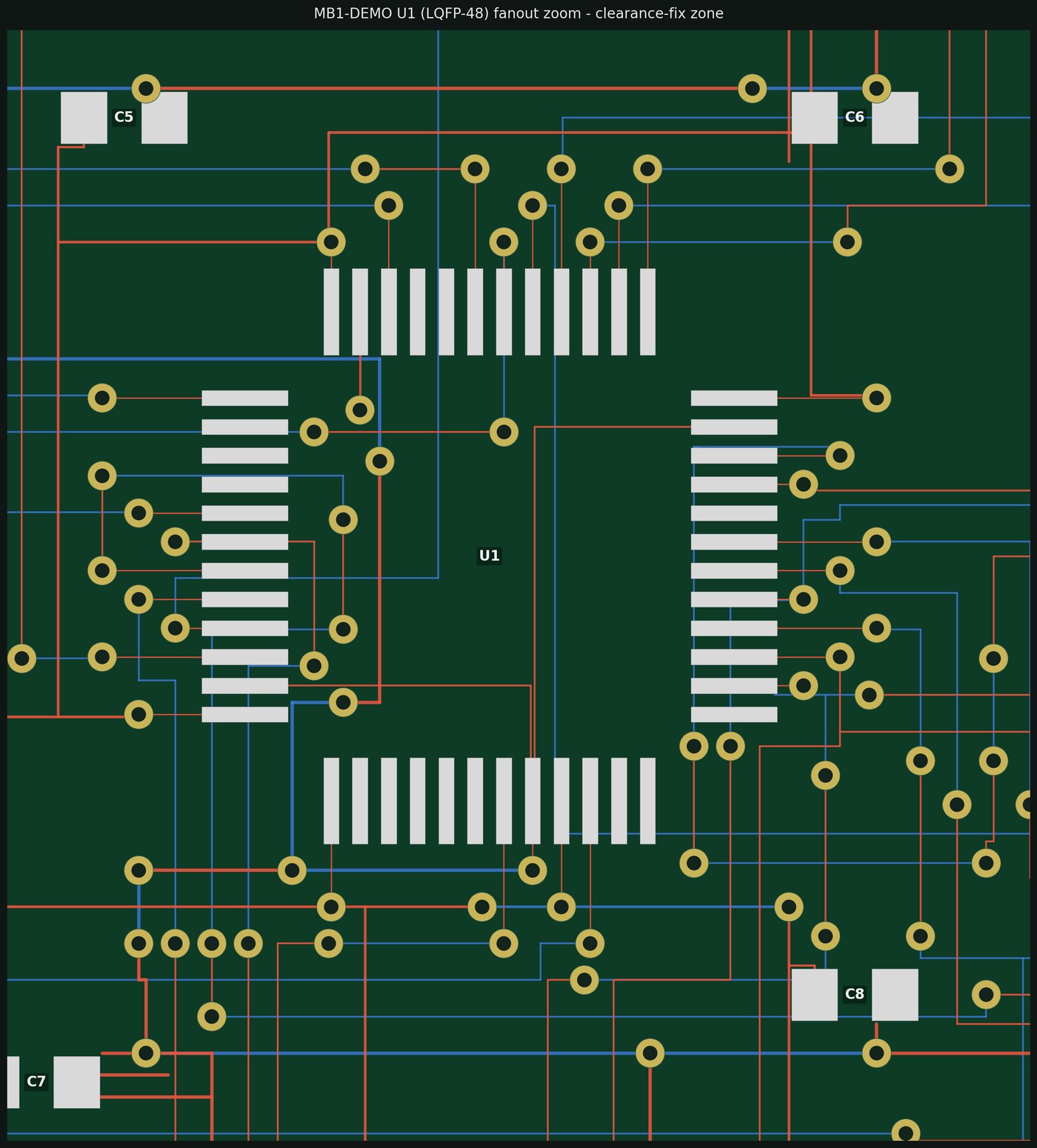
MB-1 is that algorithm as a digital ASIC design: RTL, two simulators in lock-step, Vivado synthesis, an Arty bitstream, a Yosys sky130 netlist and an OpenROAD place-and-route to a 1.79 mm² GDS. The evaluation board on the rack-2 tray is drawn from the board's real layout (467 routed segments) — a design with Gerber files, 57 clearance violations still open, never ordered. The package in the socket is a prop. The earlier page header called the board "fabbed"; that word is retired.
The rest of the building is what changed most. The fin wall of v0 was a drawing; the radiator field is now sized by a heat account with two independent view-factor methods and an ISS known-answer gate. The eight racks are booked by the grid dossier at 40/55 kW — a capacity read off the drawing, which the load account could not match to any card-priced load. The radiation account is declared not closable until sci-rad-01 hands over the surface spectrum. Every one of those statements has a script, a JSON product and a pre-registered expectation behind it.
Training stays off-chip; on-chip inference collapses to “one 16-bit random number × a run of compares.” Around the chip, six accounts.
Count the bigram transitions offline, turn each row into a cumulative distribution, normalize to 16-bit full scale, write
it into on-chip SRAM over SPI. Sampling is inverse-CDF: draw a 16-bit random number, clamp it to [1, 0xFFFF], walk
the row until CDF[i] ≥ r. No multiply, no divide, no float — comparators, a counter and a 32-bit LFSR.
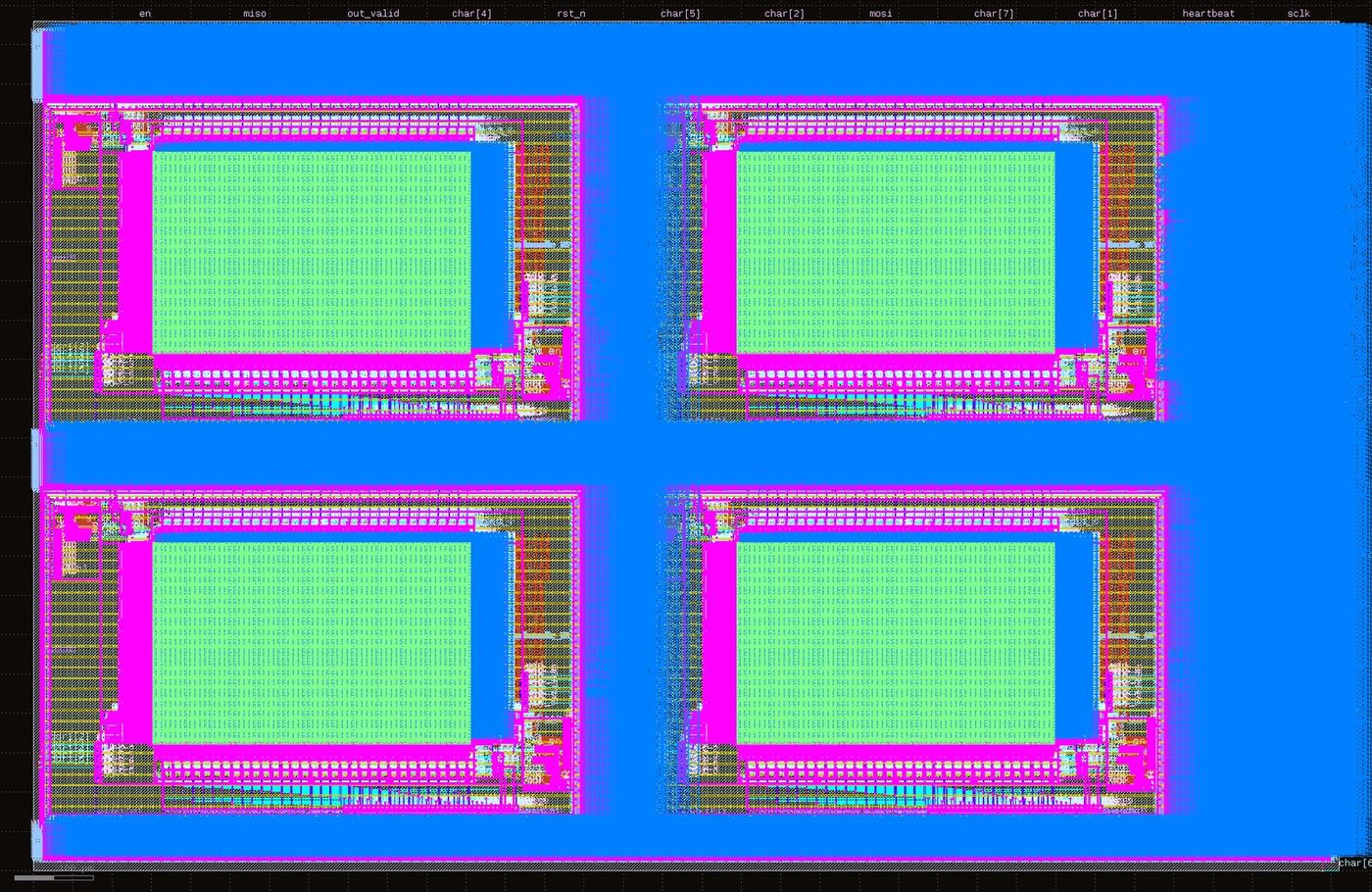
The 64-kbit table is four compiled OpenRAM macros, never flip-flops, and on the die they take 63.5% of the area.
The chip was carried through RTL → FPGA → sky130 GDS → PCB design. Three implementations agree bit for bit by log (Python golden, iverilog, xsim); synthesis and place-and-route are report-level products. Post-silicon evidence does not exist because there is no silicon.
What the city computes, by the units in it today. 35 rows, each with a card commit; 8 declared gaps. The largest compute item is the radio array's 605 GFLOP/s correlator, on site. What reaches this room is data: 15.4 GB/sol, 10.3 TB per Mars year. No card places a compute load here — the grid's 40/55 kW is a drawn capacity, and the card now says so.
IT + cooling + storage. No chiller: pumps 1.9 kW at 55 kW IT, conversion loss 1.9 kW at 96.6%, PUE 1.08. The G-C north trunk (1200 kW) carries 70 kW of served peaks — no village-type spur defect. Island share: 0 kW mandatory; the grid's 4.8 kW "SCADA UPS inside" is not endorsed, because the SCADA is in the grid's own control room.
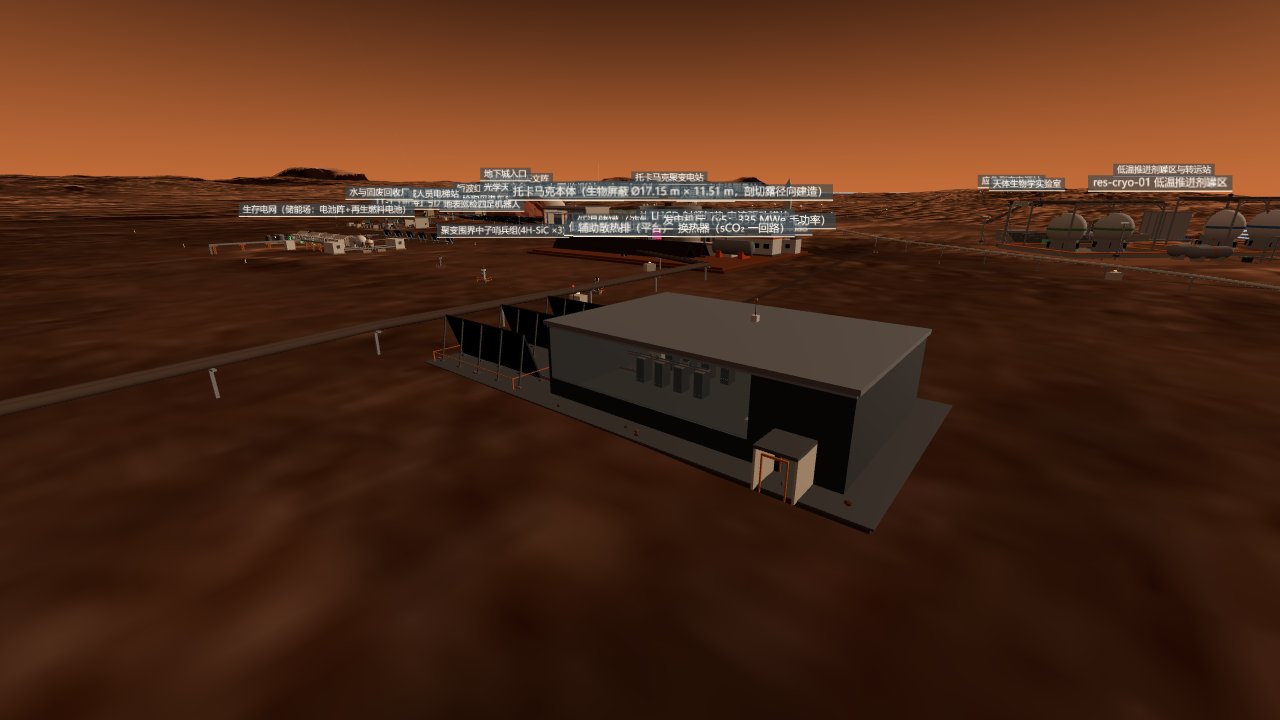
Stefan-Boltzmann to a 210 K sky and a 260 K ground, dust at α 0.68. The v0 fin wall rejects 49–69 kW at 320 K (more than pre-registered), but any sky-facing surface loses half its rejection to the noon sun once dusted. The winning family is near-vertical, north/south faces: 570 W per m² of panel at the worst noon, 889 at night. 59.4 kW needs 104 m²; 162 m² built.
Not closable, now confirmed by the holder. A surface room under 20.7 g/cm² of CO₂ and 234 mSv/yr, wall not folded in. sci-rad-01 holds no measured spectrum; its charged-particle flux is 3 /cm²/s, a background-knowledge value. The earlier 8.9 /cm²/s on this page was a pixel-hit rate per area, retired 2026-09-13. SEU is a sweep over the per-bit cross-section: in quiet time the SEC-DED verdict still flips inside the sweep; during a hard S5 event uncorrectables rise by 10⁷, so the policy needs a second knob, an accelerated scrub on the SEP alert. SEL stays unknown: it "depends on a recoil population this station cannot count with a single layer" (sci-rad-01).
23 claims of the old card and this page, each against a product. 11 supported, 5 with a stated limit, 3 partly, 2 designed-not-built, 1 with no product at all, 1 contradicted by its own report (267 LUT, retired → 212). Logs were re-run and filed so that "two simulators tick-identical" is a file, not a sentence.
In 15.4 GB/sol, out 10.7. The planet's Earth link averages 0.965 Mbps; the room is where science data lands, is reduced and is kept. The teal cable from the blade to the screen stands for a 115.2 kbit/s UART carrying ~130 bit/s; MB-1 at full speed would outrun it 200×.
Every headline number, which script or report produced it, and whether it is a design figure or a measurement.
| Claim | Value | State | Produced by |
|---|---|---|---|
| Screen sampler bit-exact vs Python golden | PASS · 220 chars @ seed 0x12345678 | measured (node + browser) | viewer/units/ops-compute-01.js + mb1-cdf-data.js; ledger/out/05_mb1_audit.json |
| Three implementations bit-exact | Python ↔ iverilog ↔ xsim · 0 mismatch | log | ledger/logs/iverilog_tb_mb1.log, xsim_tb_mb1.log |
| Two simulators tick-identical | $finish 1,131,905 ns both | log | same logs (Mars-corpus table; the old table's time retired with it) |
| FPGA OOC synth, latches | 0 · 212 LUT / 292 FF | report | syn/reports/utilization.rpt (212 formerly printed as 267 — retired) |
| FPGA Fmax | 173 MHz (WNS −0.781 ns @200 MHz) | report | syn/reports/timing_summary.rpt |
| Arty bitstream, timing | MET · WNS +3.289 ns @100 MHz | report (never loaded on a board) | ledger/logs/vivado_impl_arty.log, fpga/arty_build/ |
| sky130 logic area | 33,123 µm² · 2245 cells incl. 4 macros | report | asic/reports/sky130_stat.txt |
| SRAM macro equivalence | 11,069 reads · 0 mismatch | log | ledger/logs/iverilog_tb_cdf_sram_equiv.log |
| Full die, routing DRC | 1.79 mm² · DRC report empty | report (empty file: limit stated) | asic/pnr/mb1_pnr.tcl, asic/pnr/out/route_drc.rpt |
| Timing at 100 MHz | hold +0.14 MET · setup −0.02 VIOLATED → clean ≤ 99.6 MHz | report | asic/pnr/out/final_timing.rpt |
| Core power | 29.6 mW @100 MHz | estimate (no silicon) | asic/pnr/out/final_power.rpt |
| Final GDS | 27,550,944 B | file | asic/pnr/merge_gds.ps1 (klayout) |
| PCB net truth-table | 129 pins · 0 mismatch | file, no run log | pcb_skill/scripts/verify_sch.py + pcb/mb1_truth.json |
| Board routed | 0 routing fails · 57 clearance DRC open | log | pcb/route13.log (pcb/mb1_route_board.py) |
| Science data ingest | 15.4 GB/sol · 10.3 TB / Mars year | from cards | ledger/01_load.py → out/01_load.json |
| Digital twin render load | 2.97 M tris · 7022 calls · 55.7 ms/frame | measured | ledger/inputs/twin_measurement_2026-09-06.json |
| IT load hosted here | NOT CLOSABLE (grid books 40/55 kW capacity) | declared gap | ledger/out/01_load.json totals.hosted_here_note |
| PUE | 1.079 peak · pumps 3.5% of IT | account | ledger/02_power.py → out/02_power.json |
| Feeder served peaks | 70 kW of 1200 kW (5.8%) | from grid json | ledger/02_power.py; mars-grid out/03_transmission.json |
| v0 fin wall at 320 K | 69 night / 57 day / 49 day+sun kW | account (retired geometry) | ledger/03_thermal.py → out/03_thermal.json drawn_wall_320K |
| Panel design flux (dusted, 320 K) | 570 W/m² worst noon · 889 night | account | ledger/out/03_thermal.json two_sided_panel_table |
| ISS known-answer gate | model 259 vs ISS 147 W/m² planform (×1.76) | gate | ledger/03_thermal.py G3.1 |
| Radiator field | 3 × 12×4.5 m · 162 m² · 92–144 kW | design from account | ledger/out/03_thermal.json geometry_for_asset |
| Surface charged-particle flux | 3 /cm²/s (8.93 retired: a pixel-hit rate per area) | holder's background-knowledge value | ledger/04_radiation.py r1.1; sci-rad-01 replies e2ed278 / efa91c6 |
| SEU / SEL rate | NOT CLOSABLE (holder has no spectrum) | declared gap | dev/REPLY_sci-rad-01_to_ops-compute-01_spectrum.md + _products.md |
| LET unit conversion in Si | 1 keV/µm = 0.00429 MeV·cm²/mg (MIP check: 116.3 keV in 300 µm) | known-answer gate | ledger/04_radiation.py G4.5 |
| φ(>LET) table from the ΔE–E telescope | registered, used in no rate | design simulation, no data (sci-rad-05) | ledger/out/04_radiation.json sci_rad_05_table_2b |
| Uncorrectables in a hard S5 SEP | ×9.6×10⁶ (flux ×3103, squared) | account on an extrapolated flux | ledger/out/04_radiation.json sep_S5_sweep_64GB |
| Earth link mean | 0.965 Mbps = 10.7 GB/sol | from relay card | ledger/06_datalink.py → out/06_datalink.json |
| Blade-to-screen cable | UART 115.2 kbit/s · ~133 bit/s used | account | ledger/out/06_datalink.json cable |
| Roster and quota board | 5,136 tris · reads roster-data.js at build | hosted part (ops-roster-01), data not transcribed | viewer/units/roster-board.js + roster-data.js |
| In-city smoke test | scale 1 · 57 assets · self-test PASS · 1 console 404 (sci-rad-05 card, not this unit) | measured | dev/DELIVERY_ops-compute-01_r1_1.md |
The honest part. Two RTL bugs and thirteen routing rounds from the first build — and, this round, what the accounts overturned in the page itself.
The truth audit found three sentences that read as built where only design files exist, all three now withdrawn: a "fabbed eval board", a "gold-lidded ceramic engineering sample in the DIP-24 socket", and "MB1-DEMO revA" as if it were a board — retired on the card with the old wording kept in quotes and the date. The dossier ends at GDS and Gerber.
The stored synthesis report says 212 (200 logic + 12 distributed RAM); 267 had been carried from an earlier run into the README, the card and this page. The report wins. Same audit: "bit-exact across four tools" was three simulators plus a synthesis report; and the page printed hold slack (+0.14 ns MET) while omitting the setup violation in the same file (−0.02 ns at 100 MHz).
The v0 screen program was a floating-point bigram counted in the browser with Math.random(). The chip's table and
arithmetic now run on the screen and self-test on boot; the corpus was switched to the city's own text and every build product,
both simulator logs, the twin page and the Arty bitstream were regenerated on the new table.
Pre-registered before computing: the fin wall would reject 20–45 kW (it rejects 69 at night); day would fall 30–60% below night (17%); a sky-facing tilted panel would net 250–400 W/m² (466 for the whole panel, and the best family is near-vertical). Wrong on the inter-fin escape (31%, not ~10%), wrong on how much a dusted surface absorbs at noon, wrong on how cold the ground is. Expectations were left as written; the conclusions changed.
The radiation account divided the rad station's 62 hits per second by its chip area and printed a charged-particle flux of 8.9 /cm²/s, now retired. The holder answered that 62 counts pixels, not particles (about three pixels per track, since revised by the holder to 9.5), and that its particle flux is 3 /cm²/s. The 8.93 figure is retired. The gate that "checked" it multiplied the same two numbers back together, an identity; it is replaced by a gate on the holder's own decomposition, which closes at 197.8 against 198 hits per second.
The particle telescope sent a φ(>LET) table whose MeV·cm²/mg column used 1/2.33 where 1/233 is right; the rad station's reply carried the same slip, and this dossier had copied one such figure into a ledger file a week earlier. It is retired there. A minimum-ionising particle settles it: 116 keV in 300 µm of silicon with the right constant, 1.16 keV with the wrong one. Which LET range sets latch-up for the devices is now registered as open.
The first analytic wall model used a cavity-aperture emissivity outside its small-aperture assumption and disagreed with the ray-cast by 20%; the cross-check gate went red, the model was replaced by parallel-plate view factors with a reflection series, and the two now agree within 1.3%. In the radiation account the first gate said "the ECC verdict does not flip across the sweep" — a wish, not a mechanism — and went red because the verdict does flip. It was replaced by a gate on the formula's scaling; the flip is reported.
The grid dossier's "8 racks × 5 kW = 40 kW, agrees within 9%" with the grid's second-route figure of 43.6 kW for the v0 wall is two readings of the v0 drawing agreeing with each other. The wall figure lies inside this account's 49–69 kW for that wall; the load side matches no card. Reported back as "installed capacity, demand unpriced" rather than corrected in their file.
Widening the unit from 26 to 42 m put its west edge over the pipe-heat-2 corridor; the layout audit said ROAD CLASH. The site moved 8 m east; audit clean, placements registry updated.
Sampling off-by-one (r = 0 could pick a zero-probability symbol; clamped), a zero-width VALID pulse when READY was held high (registered valid), the SRAM that synthesized to 66,048 flip-flops until it was read as a macro, six place-and-route rounds, and the USB-C connector that deadlocked the router until it became a Micro-USB.
Walk into the compute center and read the boot log.
C for the tech city, walk to the compute center's south airlock and go in. The screen's boot log
prints MB-1 bit-exact vs python golden: PASS (220 chars) before it starts sampling — green is the gate holding, red is the gate failing.V) the ten knowledge cards: screen, MB-1, racks, CDU, radiator, power, data link, radiation, die plate, airlock.
Each carries its account's numbers, sources and the round's withdrawals.roster.json.